August 31, 2012
one hundred, sixtieth skein
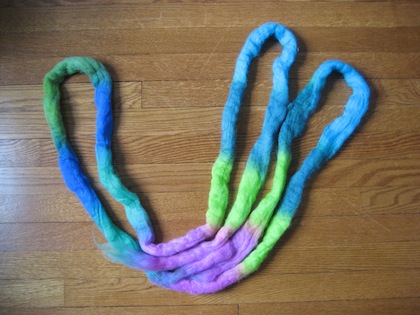
Made another bulky low-twist skein of handspun Heinz 57 wool.
The yarn is already on the språng frame and worked into a fair bit of cloth.
August 30, 2012
Single Mitt in Språng
This språng mitt doesn't work well. It's elbow length and that's weird to begin with. The double twist interlinking section over the forearm (top of photo) skews strongly and the fabric there is insubstantial. The mitt took both sections of the sprang because the cloth was narrow and it's unlikely I could make more cloth to match exactly for a second mitt. The loops at the start of the fabric are ungainly. The fabric won't conform at the wrist, much the way fallen tights wrinkle around ankles.
The humbug handspun looks better as cloth than it did as yarn. The single twist interlinking over the hand gives a soft warm fabric. When folded back and doubled, the fabric gets even warmer. The stretch makes it comfortable to wear.
I think I could make a better mitt with språng than this.
August 29, 2012
Bottom's Name in Midsummer Night's Dream
According to Asimov's Guide to Shakespeare, regarding Shakespeare's character Bottom in Midsummer Night's Dream, "one of the numerous meanings of 'bottom' is a 'skein of thread.'" Thus the bard gets, with the donkey jokes, a twofer of a pun.
August 28, 2012
May Need to Switch Wool Breeds for Better Results in Språng
I probably need to switch the type of wool breeds I use for yarn in the språng fabric I am making. The grey piece I showed you is Blue Face Leicester, and BFL strands stick to each other. This is a problem when trying to force the twists down to the bottom of the warp.
The bottom part of the cloth turned out to be four inches longer than the top, roughly twenty-five percent longer, and I had to spend time adjusting its twists which led to adjusting the top as well to match the newly compacted twists in the bottom. This is a chore I would rather avoid.
The lengths are even now and I've worked twist into about as much of the warp as I can manage. Time to decide whether to finish it as a sample piece or to seam it into some wearable fingerless mitts. Friends and family have been agitating for something real and usable to come out of my sample pieces.
The sample piece of språng with the diamond pattern of holes gets the best response from people seeing the assortment I've build up.
I have a couple of down breed wool skeins of handspun on hand that might go into the next warp I make. I can't imagine that yarn would stick together.
The bottom part of the cloth turned out to be four inches longer than the top, roughly twenty-five percent longer, and I had to spend time adjusting its twists which led to adjusting the top as well to match the newly compacted twists in the bottom. This is a chore I would rather avoid.
The lengths are even now and I've worked twist into about as much of the warp as I can manage. Time to decide whether to finish it as a sample piece or to seam it into some wearable fingerless mitts. Friends and family have been agitating for something real and usable to come out of my sample pieces.
The sample piece of språng with the diamond pattern of holes gets the best response from people seeing the assortment I've build up.
I have a couple of down breed wool skeins of handspun on hand that might go into the next warp I make. I can't imagine that yarn would stick together.
August 27, 2012
The Movement of a Strand in Single-twist Språng Interlinking and Double-twist
Did this practice piece to show the movement of a strand in single-twist språng interlinking and in double-twist. A strand stays pretty much vertical in single twist: it zig-zags slightly back and forth. Once you start double twist, it inches toward the side, then reverses course. You can see two strands in burgundy on the grey background. They run parallel down from the top, then cross and diverge.
I had a good time at the event on the weekend, as you might expect I might around people at leisure who are interested in doing arcane fibre arts. Gave away a spindle to a beginner. Spun a little. Showed the belt tool to a woodworker and talked about mechanical considerations in card weaving, such as how a weaver-tensioned setup gives a firm warp-faced weave, potential drawbacks of wooden tablets, that sort of thing. Distributed fibre festival brochures. Showed samples of språng, discussed it, and demonstrated it. Got to see someone's språng water bottle cover. Tried to work a diamond pattern in språng and forgot how. Fell back on simple 1/1 interlinking, as you see. Left a mistake at the top which moved the two burgundy threads wider apart, a result I think makes its appearance more interesting.
August 25, 2012
Have Språng Frame, Will Travel
I'm throwing a bunch of tools and supplies in a pile in anticipation of taking them to an event where I'm assured there will be people likely to want to try their hands at some tablet weaving, språng, or drop spindle handspinning.
Am going to have to sort through the pile to make sure all the essentials are there. It's simple, portable stuff but one missing piece could scupper my ability to warp, weave, or work sprang.
August 24, 2012
Changing the World One Spindle at a Time
Our last handspinners guild meeting was held in a more public place than usual and we had some walk-ins. I'd brought a couple of inexpensive drop spindles with spare wool. I was able to give one away to someone who'd never spun yarn before, and told my friends that I was one up on my plan to change the world. They think it's slow progress.
August 23, 2012
Card-woven Belt in 70s Colours
I warped this belt in January in order to show a couple of guilds a setup for weaver-tensioned card weaving (tablet weaving) and let the guild members try if they liked.
The cotton yarn was generously donated by another member. The colour contrast made it easy to see where individual threads were positioned and how they moved from shed to counter shed. It was also good to work from four cones of yarn because that allowed me to use the quick method of continuous warping, which I prefer.
A few people tried weaving a small amount. Then the warp sat on the cards and cloth-beam-belt-tool thing for months while I nurtured hopes that someone else would want to learn. Then an occasion came up requiring a belt. In one day, I undid the weaving back to the first two inches (which I now wish I'd taken out as well because the weft is too loose there) and I started again, finishing the whole length. Strike one more unfinished object off the list. Hurray for deadlines that prompt action.
I regret that I didn't stagger the position of the cards to produce a chequered pattern. The harsh stripes make me think of coral snakes.
I am happy about the looped end, it's the first time I've tried a wrapped loop after Collingwood's The Techniques of Tablet Weaving. A woven loop is more elegant and tidy but cuts the warp length in half and I needed a long warp for a belt.
The feel of card-woven cloth is pleasantly substantial. Here you can see the side, how thick the belt is. The photo is taken at a reversal line, where I had to stop turning the cards forward by quarter turns and start turning them backward because too much twist had build up in the warp. Card weaving is warp-twined. Each place you see a blotch of a thick stripe in the photo above, that's a reversal line. I reversed wherever the yarn dictated without any sort of plan and I didn't bother finessing the selvedges by reversing the outside cards at a different spot.
August 22, 2012
2/2 Diamond Pattern on 1/1 Språng Background
Once I learned how to do all-over 2/2 holes, it was a short step to making a pattern of holes on a background of 1/1 språng interlinking. Nice, eh? From the books and their charted patterns of lacy holes like this, I take it that the structure of språng interlinking cloth lends itself to designs worked in diagonals. Zig-zags. Double-headed eagles. I'm not doing double-headed eagles.
I will point out an error on this piece, I didn't compact the lower half enough and it's longer than the top half.
Can you see how the pattern's centre row bulges a little in width? It's the row with three holes across it, where the dot is in the middle of the diamond. Holes stretch the fabric out, so their placement can act as garment shaping. That's a way to make the cloth wider or narrower to fit the form underneath.
There are other means of garment shaping in språng. For a couple, I want to get some yarn in a contrasting colour in order to show clearly what the yarn does.
This piece of cloth was made with my one hundred, fifty-ninth skein which went directly from spindle to språng frame without touching a niddy noddy or swift.
August 21, 2012
Sprang Cloth with 2/2 Holes Throughout
Collingwood's The Techniques of Sprang says that the simplest way to understand how holes are made in 2/2 språng interlinking is to make them all the way across. So I did.
Two threads are passed over two threads, rather than one over one (1/1). That's not all there is to it, there's a four row sequence I had to follow. Didn't throw me off, not like knitting feather and fan did, probably because within one row the motion is the same all the way across. I made one error about a third of the way down from the top.
The fabric stretches sideways considerably, more than the multiple twist interlinking I did last time.
I like the cloth's texture. I wonder what it would look like in fine yarn.
August 20, 2012
Glut of Events
According to my calendar, there is a fibre event on each of the next seven, no, scratch that, nine Saturdays. Some days have more than one option. Plus, there are a few Sundays with fibre events. And I just went to one this past weekend.
Some are just for fibre folk and other events are out in public.
This much choice is great and kind of staggering.
Some are just for fibre folk and other events are out in public.
This much choice is great and kind of staggering.
August 18, 2012
A Loom Up and Running
Once upon a time there was a second-hand rigid heddle loom in a friend's attic. I came over, bringing bits and pieces that were needed like a shuttle and a sleying hook. Together we put a warp on the loom and got her and her children weaving.
First we watched Ashford's online video about direct warping. After that, everyone knew what the next step was and could pitch in with confidence.
August 17, 2012
Språng Multiple Twist Interlinking
The openings in the cloth are held open by various amounts of multiple twist in the interlinking, some one, some two, three, or four.
The photo shows the start of the cloth at the top. I worked downward. In the cloth at the top I compacted the rows but at the end, near the meeting line, the rows are looser. I wish I'd been more consistent. The uncompacted rows skew less and look better.
The fabric stretches sideways a lot. As you can see, the fabric looks more like mesh than plain interlinking does.
I tried this type of språng because I thought the diagram in the book looked pretty. You start with one twist, then as you work across the row the next interlinking has two and so on building up to four, then you reduce the number of twists in each interlinking, then build up again. Then the next row you offset this; you start with three twists, then decrease the number of twists in each interlinking, then increase. One row's height waxes while the other wanes, with an effect like waves. That's the theory, the actuality is rather blurred. Could be my fault for using a somewhat fuzzy yarn. Didn't help that for one row I wasn't thinking and did interlinking with four twists all the way across.
Multiple twist interlinking is part of the Bronze Age hair-net shown in the book. I think looking at the plate that while different rows have different amounts of twist in each interlinking, within a row the number of twists is the same. That would be more simple to work. The handspun wool yarn must be a firm sort as the twists appear well defined.
August 16, 2012
"It really works to have it local"
I watched an online interview expecting to be annoyed because the topic was 3D printing's potential to change the future of textile production. I spin yarn by hand to make cloth, I like natural fibres not synthetics, and I'm interested in cloth structures composed of individual strands orderly arranged, not fused layers. But I liked what New York-based designer Mary Huang said about local production:
I think that there is a lot going on right now that seems to say that for certain products it works really well to manufacture in the U.S. We actually get other products made in the garment district and I know other designers do as well because for things that are smaller quantity, higher quality, and more interesting designs, it really works to have it local. You get faster iterations. You have better quality control. You already have the margins to be able to do it locally, so why not.I also liked Huang's bespoke approach. As I looked further into the Kickstarter campaign, the main website, and the blog, I could see that she and Jenna Fizel, also of Continuum, work with ways to customize clothes to an individual, following the wants and needs of the final owner as well as the inspiration of the designer and the limits of the clothing construction methods. This is an approach that is shared, I think, with handspinners making yarn and cloth. No one that I know makes standard repeatable yardage in handspun the way the ancient or medieval world did; rather, handspinners experiment with fibres to get a custom product.
–Mary Huang of Continuum Fashion interviewed in "Printing Fashion: Fashion label blends tech and couture," CBCNews Business, The Lang & O'Leary Exchange, August 10, 2012, http://www.cbc.ca/player/News/Business/ID/2266188756/
August 15, 2012
August 14, 2012
A Sprang Image on the Visual Arts Data Service
Found an online image of a Coptic wool bag in språng at the Visual Arts Data Service website, http://www.vads.ac.uk/large.php?uid=32261&sos=4. Going by Collingwood's book, the two-toned patterned area is probably worked in double cloth, creating patterns in colour where the strands swap places between the two layers. The red edges are probably worked in a single layer of cloth.
The piece is more intact than the piece Collingwood included in his book's plates, and it's in colour. Collingwood's book is in black and white.
August 13, 2012
Hankies
A little over a dozen linen handkerchiefs, newly made.
They're not for show or gift-giving or living a twee life, they are for me to use as a durable and practical alternative to tissues. (I also have this ambition to have linen in my life as much as possible. I like the feel of linen much better than disposable tissues.)
I cut the store-bought cloth into pieces a couple of years ago and at the time I sewed up a dozen and a half. That stack has seen continual use. The amount was almost enough to last between washdays whenever I was afflicted with a cold and more than enough otherwise. It will be nice now to have ample.
The hankies are simple, no embroidery or monograms. The cloth is plain-weave. The size is about the same as a tissue.
I enjoyed sewing the seams by hand over several evenings. It's satisfying to have the project off the to-do list. If I had to do it over I would have bought a thicker weight of linen, rather than cloth described as fine handkerchief linen.
I read somewhere that in the old days linen cloth was pressed to make it stain-resistant. I didn't test stain-resistance, but I tried using my handkerchiefs both ironed and un-ironed to see how they felt. I like the look of them better ironed but they feel more absorbent when un-ironed.
August 10, 2012
August 09, 2012
Z Twist Språng Interlinking with S and Z spun handspun
| in progress |
The fabric curled to a significant degree, almost as much as with handspun all of one type. However, the appearance of the surface is different, pebbly not smooth. Side by side one yarn has twist added while the next has twist removed and so they heave out of plane. The top and bottom sections resemble each other more closely in the look of the yarn's twist than the previous experiment's sections did.
| right after being taken off the frame |
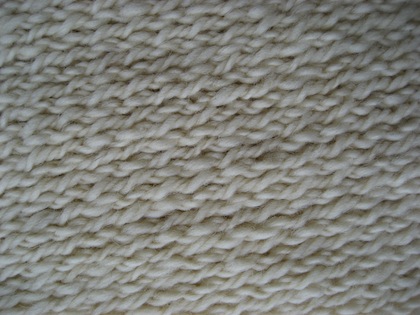
Here you see the fabric folded in two, one layer behind the other, and stretched.
For both kinds of handspun the yarn twist is a regular twist, not a low twist, and the fabric has a harsh feel, in contrast to the piece I worked in low-twist handspun. There is comparatively little halo to the wool.
August 08, 2012
Plain Weave vs Pattern Weave
Here's a quote from Mary Atwater's American Hand-weaving (New York: Macmillan, 1928) that surprised me:
Good thing I didn't read this passage before I made my plain-weave vest, I might have doubted the wisdom of plain-weave for my first woven cloth.
It is far more difficult to weave a satisfactory plain-weave fabric than it is to make a piece in simple pattern weaving. For the sake of logical sequence the plain weave is considered here, but the beginner is advised to pass on to the chapter on the four-harness overshot weave. In plain weaving slight variations in beat show as very obvious streaks, especially if warp and weft differ in color and an even beat comes only with practise. (p. 109)I suppose it's similar to what they say about how difficult it is to construct twentieth-century modern architecture and furniture compared to Georgian, Victorian, and such because there is no ornamentation, there is nowhere to hide irregularities and misalignment.
Good thing I didn't read this passage before I made my plain-weave vest, I might have doubted the wisdom of plain-weave for my first woven cloth.
August 07, 2012
"I Had No Idea How Much Emotion I Could Feel Over These Things"
"Rescuing a Dying Art"
Jennifer Gaudet of Jennifer's Hamam, interviewed by Kimberley Strathearn about rescuing looms in Turkey and re-employing skilled production weavers.
According to the Jennifer's Hamam website, their Turkish bath towels can be expected to last twenty years, much longer than factory-made towels, because the cloth is constructed using shuttles. I find it interesting when people point out a link between structure and functional performance.
In the article "Towels Fit for a Sultan," Today's Zaman, December 8, 2010, http://www.todayszaman.com/news-229022-towels-fit-for-a-sultan.html, Gaudet talks about the weavers, their equipment and how they work. She says, "It takes two to six days to weave one big 1.8 kilogram towel and one to three weeks to weave a bathrobe."
You can find videos of the weavers in action through the Jennifer's Hamam Facebook page. They use fly shuttles, their weaving is rapid and noisy with a rhythm. The looms are similar to the looms in the video of Harris tweed weavers I linked to in a previous post.
In the article "Towels Fit for a Sultan," Today's Zaman, December 8, 2010, http://www.todayszaman.com/news-229022-towels-fit-for-a-sultan.html, Gaudet talks about the weavers, their equipment and how they work. She says, "It takes two to six days to weave one big 1.8 kilogram towel and one to three weeks to weave a bathrobe."
You can find videos of the weavers in action through the Jennifer's Hamam Facebook page. They use fly shuttles, their weaving is rapid and noisy with a rhythm. The looms are similar to the looms in the video of Harris tweed weavers I linked to in a previous post.
August 06, 2012
Monday, Wash Day
A few freshly ironed linen shirts. Love the red one in front, both the colour and the heavy fabric. It's a choice thrift store find, and the modest price was discounted fifty percent which is even better. I mean to cut it up and sew something. Probably a project bag to hold knitting or a spindle and wool. I could make a pinny, a nicer sort than the crumpled red school pinnies we had to put on in P.E. to tell one sports team from another, but I have no use for one.
I checked the red top against an asymmetrical top in drab worn linen I picked up secondhand a while back on hopes of recreating it someday in a nicer fabric. I can get enough fabric from the red top for the main body but not enough for bias binding.
At another thrift store, I got a jacket that's the same label and same fabric as the dress I cut up and made into a project bag this Spring. I want to alter the jacket a little and wear it. For the few dollars I paid, I can chance ruining the jacket's structure and fabric by cutting out the synthetic fabric lining and unpicking the patch pockets. The plastic buttons have to go. I will replace them with shell buttons I salvaged a couple of years ago from a thrift shop dress. The shell buttons have a glossy good side that looks wrong against the rustic fabric but the dull, mottled reverse goes well and as a bonus will amuse me since the colouring is similar to a tortie cat.
I bought for myself a men's linen camp shirt from J.Crew and I took off the pockets. The cloth is chequered and the pockets have bellows pleats. The folds mean that the pattern does not line up and the pockets stand out. Did I mention the pockets are chest pockets? Chest pockets that draw attention to themselves, yes. And now on my shirt they are gone. A small detail can make all the difference to wearability. The beautiful linen fabric closed up in the wash leaving no trace of stitch marks. I will swap out the plastic buttons soon for some thick, white shell buttons from my button box.
When I washed the dishes wearing the camp shirt and the blue linen apron I sewed in June, I looked almost together.
August 04, 2012
Z Twist Språng Interlinking with Loosely-spun Handspun
It is true, språng fabric wants to twist when you work all Z twist interlinking. The top photo is taken squarely facing the frame on which the threads are stretched, and you can see how the cloth twists. Once taken off the frame, it really twisted.
You can see from the ends of yarn hanging loose that the yarn was spun Z and plied S, which means that the språng Z twist interlinking on the top section slants in the opposite direction of the yarn. In contrast, the bottom section shows in reverse whatever I do at the top and there the interlinking slants in an S direction. The twist of the interlinking fabric affects the strands of yarn, either undoing the yarn's twist or making it tighter. The fabric reflects this: I can see the twist in the yarn in the fabric's bottom section but it is hardly visible in the surface at the top. I like the look of the bottom section, that is, the section interlinked in the same direction as the yarn was plied.
The fabric is nice to the touch. As with my first two samples, it's fun to pull the cloth sideways to see the interlinking. Though the fabric corkscrews when held in the air, it lies flat when I fold it at the meeting line in the middle and set it on a table. Again this is a confirmation of what Collingwood has written. Nice to have a tangible example at hand. The sample is good for showing språng to people who haven't read the book and may never do so. The structure of this piece is easier to grasp than the last two. There are more variations to try out and prove.
The next experiment will be with the two yarns I spun, one spun Z and plied S and the other spun S (widdershins) and plied Z. I know I will arrange them on the frame AABB, but I am trying to decide whether to work all Z twist interlinking again or whether to work the cloth's right side with Z interlinking and the left side S. I think that would make the top and bottom sections exactly the same. Working all Z twist or all S twist would not. When you think about one portion of språng cloth turning out a little differently than the other, this has design implications for a piece of cloth to be worn. Since I intend to make myself something wearable with språng, I must mull this over. I can take very strong likes and dislikes to things, and I like to get what I like. Don't we all! It would be good to find a technical solution, a means to get the effect I like without completely discarding half the cloth.
I had another look at Blue Swan's pullover. She says on the page that the pullover is warm to wear. She worked so many holes in the interlinking, it's nice that it's warm even so. Plain interlinking has holes enough in my opinion. This is probably why I worked my interlinking so tightly, to minimize the holes. Tight interlinking is supposed to worsen the corkscrew effect.
What else did I learn? The amount of tension on the frame doesn't seem to matter much. Not like weaving where fabric goes flooey when the tension is loose.
I had crochet cotton on the frame last week and couldn't get anywhere with it.
August 03, 2012
The Way Thrift Stores are Jammed
A quote from Brian Ulrich, of VCU, discussing his book Is This a Great Place or What in an interview on With Good Reason, July 28, 2012, http://withgoodreasonradio.org/2012/07/is-this-place-great-or-what/
I was out for a walk the other weekend and came across a yard sale that was mostly clothes. I could tell from eavesdropping that it was in effect an estate sale, the mother had died. There were conservative men's suits on hangers laid over boxes; I could imagine a widow keeping them, deferring the task of processing the things. Pieces of women's clothing were hung on makeshift rods and heaped on tables and blankets. The adult daughter apologized to me for the disarray. So much stuff. Underpinnings and everything. Much of it was nice, Sunday-go-to-meeting level. I'm sure each purchase seemed like a good idea at the time.
The second half of the broadcast is an interview with Scott Nelson about his book A Nation of Deadbeats. I couldn't pick out any one quote, it was just riveting with facts I had never heard of. It's snippets of stories about economic history centring on the consequences of debt and gluts of goods on the market, such as used British military coats after the Napoleonic war.
On the cover of the book there's a photograph of a young woman who was working in a thrift store in Seattle, Washington and she's really kind of totally surrounded by a giant pile of used donation clothes. To me what was amazing about this girl was that she was maddona-like. She had this ownership of herself in that space even though she was totally compressed by this wall of colour and garments and stuff.
This is this environment that we all exist in. The thrift chapter of the book moved into the idea of "as much as we buy things, those things have to go somewhere." There has to be a repository for those things. The middle class casts off all of their used things, they end up in this space, the guilt is absolved but the mountain of stuff is tremendous and profound, and a real problem that people have to deal with all the time...
[On the influence of Hurricane Katrina] Like a lot of people I was completely transfixed by the aftermath which was poor people and low-income people trapped in New Orleans. It made me think of the fabulous photographs that were done in the 1930s of the Depression-era America. It seemed a lot more interesting to potentially just photograph that level of "here's what the environment is" in the thrift store.
Interviewer Sarah McConnell: And what did you find the environment to be?
Ulrich: Consumer goods were being manufactured so fast that they had to be spit out of the machine, and this was where they landed. They literally would be piled to the ceiling, spilling out of the back of stores. These places were swimming in consumer goods. Most of the time we like to think, oh, that's a great thing: they're going to be able to sell all this stuff and use that money for a charitable organization or otherwise. But it was a real problem. They couldn't get enough people to process this stuff. And to lay that all on a lower economic class was big and heavy and again problematic.
It seemed to me that thrift is an allegory for a culture that sets in place a remedy for a system so that the people in the thrift stores and the thrift stores themselves are the ones to solve these last-level problems of "well, we make too much stuff. You deal with it." Upper and middle-class levels get to reap all the rewards and benefits of new products; lower income gets to basically glean from what's left behind.
McConnell: And the way that thrift stores are jammed, they can't even glean because they can't even process what they see.
Ulrich: No, they can't. It's incredibly...yeah.I heartily enjoy buying from thrift shops and other resellers and I appreciate having places to consign or pass along my useable discards. But, yeah.
I was out for a walk the other weekend and came across a yard sale that was mostly clothes. I could tell from eavesdropping that it was in effect an estate sale, the mother had died. There were conservative men's suits on hangers laid over boxes; I could imagine a widow keeping them, deferring the task of processing the things. Pieces of women's clothing were hung on makeshift rods and heaped on tables and blankets. The adult daughter apologized to me for the disarray. So much stuff. Underpinnings and everything. Much of it was nice, Sunday-go-to-meeting level. I'm sure each purchase seemed like a good idea at the time.
The second half of the broadcast is an interview with Scott Nelson about his book A Nation of Deadbeats. I couldn't pick out any one quote, it was just riveting with facts I had never heard of. It's snippets of stories about economic history centring on the consequences of debt and gluts of goods on the market, such as used British military coats after the Napoleonic war.
August 02, 2012
one hundred, fifty-sixth skein
Two squishy ounces of Heinz 57 wool top, spun with lower twist than usual. I spun on my spindle then spun back for a count of four before winding on. I want a low-twist yarn to see how it works in sprang cloth, whether the bias cloth twists out of shape less than with high-twist yarn as Collingwood says in his book The Techniques of Sprang.
This is a pleasantly tactile skein compared to the last two I did in the same wool with the regular amount of twist. I've got it in my hand and am resting my chin on it. (It smells more of sheep than your usual wool top. Pfffhah!)
I spun the yarn while listening to an old BBC film production of Shakespeare's Coriolanus. I finished spinning when the hero's mother kneels to him in petition a second time in Act V, just before she disowns him and he caves. Charming, absolutely charming. Plying my yarn took longer, I didn't keep track of the time.
August 01, 2012
Henry V: Dye Room
Henry V: Dye Room | Behind the Scenes | Stratford Shakespeare Festival
http://www.youtube.com/watch?v=hcvO4ZQAgug
This 2012 video is from the Stratford Shakespeare Festival in Canada and shows a gambeson being over-dyed.
I love it when you can see the logo on the dyer's apron: Lee Valley Tools.
For a total co-incidence, a costume designer talks about over-dyeing military outfits from a different production of Henry V, in an article by Eliza Kessler, "Henry IV and Henry V: Q&A with the costume designer" BBC, July 5, 2012, http://www.bbc.co.uk/blogs/tv/2012/07/henry-iv-v-shakespeare.shtml. She also talks about research and practical considerations.
July 31, 2012
one hundred, fifty-fourth and fifty-fifth skeins
My one hundred, fifty-fourth skein is an ounce of Heinz 57 wool, two ply, and the singles spun to about 18-20 wpi, though I was aiming for 16. Much, much thicker than my usual. I spun it while listening to a film production of Shakespeare's Richard II and the DVD player gave me my start and end times. For the little yardage I got, I sure spun for a long time. I got all the way to
The one hundred, fifty-fifth skein took fifteen minutes less. It's the same except spun the opposite direction so I can try an experiment in språng cloth structure.
Still haven't found my camera, and anyway, the skeins aren't very noteworthy apart from being bulkier than my usual style.
Queen: And must we be divided? must we part?in Act V which is pretty bad. Next time, I thought, I will spin and not stop every other minute to check my gauge.
King Richard: Ay, hand from hand, my love, and heart from heart.
The one hundred, fifty-fifth skein took fifteen minutes less. It's the same except spun the opposite direction so I can try an experiment in språng cloth structure.
Still haven't found my camera, and anyway, the skeins aren't very noteworthy apart from being bulkier than my usual style.
July 30, 2012
No Surrender - The Hollow Crown: Henry V
You want to insult somebody and boast? Tell him you're gonna take his coat.
And my poor soldiers tell me, yet ere night
They'll be in fresher robes; or they will pluck
The gay new coats o'er the French soldiers' heads,
And turn them out of service.
–William Shakespeare, Henry V, Act IV, scene III
And here is a gratuitous Shakespeare clip, just because the music is good, the modern setting is cool, and it's so fun to identify the characters:
July 28, 2012
"Spinning the Wild" article
Some notes about nettles I took from Judith MacKenzie's "Spinning the Wild" article, Spin•Off Winter 2009, p. 56:
-impervious to water and mildew
-collect in late summer or early fall
-look for the stem to yellow two-thirds of the way up, after seeds start to form
-collect before the seeds absorb all the oil from the stalk to get durable fibres
-pull up by the roots
-let dry hanging by the roots
-when dry, strip leaves and roots
-use water retting
-stop retting when the outside layer comes off when rubbed between fingers
-rinse and let dry
-comb
-spin wet
And I will tuck that information away in case I get the chance to collect some nettles.
-impervious to water and mildew
-collect in late summer or early fall
-look for the stem to yellow two-thirds of the way up, after seeds start to form
-collect before the seeds absorb all the oil from the stalk to get durable fibres
-pull up by the roots
-let dry hanging by the roots
-when dry, strip leaves and roots
-use water retting
-stop retting when the outside layer comes off when rubbed between fingers
-rinse and let dry
-comb
-spin wet
And I will tuck that information away in case I get the chance to collect some nettles.
July 27, 2012
The Textile Tools of Colonial Homes
A quote from Marion Channing's The Textile Tools of Colonial Homes: From Raw Materials to Finished Garments Before Mass Production in the Factories (Marion, MA: Channing Books, 1982):
Channing doesn't restrict her information to American colonial tools. For example, she states that there are spindles in the museum at Housesteads Fort on Hadrian's Wall.
So everyone spun years ago, just as most everyone drives today. One might substitute "automobile" for "spindle" in the following sentence from "Book of Husbandrie" by Anthony Fitzherbert, dated 1523. "No rank is above the use of the spindle; princesses only have them gilt." (p. 25)Besides the quote, I like the author's use of primary sources. Channing refers to museum holdings, archival documents, and a number of works of art that give historical information through their depictions of textile artists or tools. These include Millet's "The Spinner" and "The End of the Village of Greville," and Van Gogh's painting of a weaver in the Museum of Fine Arts in Boston, MA, Romney's portrait of Lady Hamilton, Hogarth's "The Idle Apprentice," and a Giotto fresco in the cathedral of Florence's bell tower.
Channing doesn't restrict her information to American colonial tools. For example, she states that there are spindles in the museum at Housesteads Fort on Hadrian's Wall.
July 26, 2012
V&A Conservation of an 8th-century Egyptian Tunic
http://www.youtube.com/watch?v=-cdhnORIAvo
"Conservation of an 8th-century Egyptian tunic"
Such a contrast between the flat piece on the table in the video–so simple apart from the ornamentation–and the reproduction piece, how the tunic drapes when worn and fits the forearm snugly.
This post is rather long and even more finicking than the last one, sorry.
Burnham's Cut My Cote shows a similar piece from the 4th century along with a diagram that lays out how the cloth is woven on a warp-weighted loom from one sleeve cuff down to the other, then turned sideways to wear. This is why the Victoria & Albert museum conservator, Elizabeth-Anne Haldane, indicates in the video that there was a selvage originally at the back hem. Not that woven cloth can't have three or four selvages, but in this tunic let's say two. The (weft-wise a.k.a. hem to hem) width dimension (252 cm / 99 inches) in Cut My Cote would make the loom wider than I can find in a quick read of the beam dimensions of much later Northern European looms listed by Hoffmann in The Warp-weighted Loom; these run around 200 cm.
Burnham discusses the underarm holes and the tuck that appear in the video. Haldane says the tuck indicates the height of the original wearer. Burnham calls the tuck a way to adjust a one-size-fits-all tunic. You see how the hem curves when the man lets his arms hang down. Burnham writes that the hem hangs straight when the tuck is sewn in a curve.
I suppose the sides of the V&A's replica tunic are sewn together. Burnham's diagram shows that the side seams don't have to be sewn due to the unwoven warp threads in the corners which are "later cut to make short side fringes."
Burnham calls this style "a seamless robe," a phrase that might interest Christians because of these verses in the Bible:
Then the soldiers, when they crucified Jesus, took His outer garments and made four parts, a part to every soldier and also the tunic; now the tunic was seamless, woven in one piece. So they said to one another, "Let us not tear it, but cast lots for it, to decide whose it shall be"; this was to fulfill the Scripture: "They divided my outer garments among them, and for my clothing they cast lots."There is a footnote in the NASB that says translated literally the tunic was woven "from the upper part through the whole." The NIV's translation is "woven in one piece from top to bottom" which might lead you to think in terms of clothing construction, from neck seam to bottom hem. However, consider how a warp-weighted loom is used, that weavers construct cloth on it working from the top beam downward, so:
-John 19:23, 24 NASB
http://www.youtube.com/watch?v=NpbnQhXL39Y
"Greneveving - Ratnogoddin del. 4.flv"
(The video shows a blanket being woven, not a tunic. A blanket is woven across the whole width. For a tunic, the sleeve portion is woven and the right and left sides are left unwoven until the body section is reached.)
Using a different method, double weave, you could construct a seamless tunic from the neck to the bottom hem. It's possible to wear a long unshaped piece of cloth without seams (also woven on a warp-weighted loom), as with the chiton. So I'm not saying that the tunic above is the sort of garment Jesus wore for sure.
Some, who find significance correlating aspects of Jesus' life with parts of the Old Testament, make something of how Jesus had a seamless robe and the high priest Aaron wore a seamless robe to minister in the tabernacle in Moses' time. They also make something of how Jewish law forbids a high priest to tear his clothes (Leviticus 21:10). The relevant passages in Exodus don't specify a seamless robe exactly that I can find:
You shall make the robe of the ephod all of blue. There shall be an opening at its top [footnote states "at its top" could also read "for his head"] in the middle of it; around its opening there shall be a binding of woven work, like the opening of a coat of mail, so that it will not be torn.Italicized words are ones added by the translators for clarity, not translated word for word; therefore you can skip the phrase "at the top." You see in the video that the opening for the head is in the centre of the flat cloth. It's not merely in the centre in terms of bilateral symmetry (at the top centre of the tunic's width when worn); it has quadrilateral symmetry. The V&A tunic makes it clear how an opening for the head could be in the middle of a robe.
-Exodus 28:31, 32 NASBThen he made the robe of the ephod of woven work, all of blue; and the opening of the robe was at the top in the center, as the opening of a coat of mail, with a binding all around its opening, so that it would not be torn.
-Exodus 39: 22, 23 NASB
Exodus may not say it but historian Josephus says the Jewish high priest wore a seamless robe in the tabernacle:
The high priest is indeed adorned with the same garments that we have described, without abating one; only over this he puts on a vestment of a blue colour. This also is a long robe, reaching to his feet, [in our language it is called Meeir,] and is tied round with a girdle, embroidered with the same colours and flowers as the former, with a mixture of gold interwoven. To the bottom of which garment are hung fringes in colour like pomegranates....Now this vesture was not composed of two pieces, nor was it sewed together upon the shoulders and the sides, but it was one long vestment so woven as to have an aperture for the neck; not an oblique one, but parted all along the breast and the back. A border also was sewed to it, lest the aperture should look too indecently: it was also parted where the hands were to come out.Similarly Josephus states that later in Solomon's temple the high priest wore "a blue garment, round, without seam, with fringe-work and reaching to the feet." (p. 556)
–Josephus: Complete Works, trans. William Whiston (Grand Rapids: Kregel Publications, 1960) p. 74
The V&A tunic and Burhnam's diagram have no sewing on the shoulders, only under the forearm.
I guess what I'm saying is that a reader gains more from a text when he or she learns about the text's contextual material culture, or at least older material culture than ours that contained holdover technology. Your eyes don't glaze over anymore when you read archaic weaving instructions once someone lays out a really old tunic and talks you through it.
July 25, 2012
The Φ in Osberg
I found the dimensions of the Oseberg frame (an archelogical find from a sunken Viking ship) in small print in the end notes of Hoffmann's The Warp-weighted Loom: height 119 cm and width 75 cm at the base (about 47 x 29.5 inches).
I plugged that into the calculator: 119 divided by 75 = 1.5866. That's so close to the golden ratio, Φ, phi, 1:1.618, the proportions the Parthenon were based on. Ooooh, aaaah.
I am using artist canvas stretchers for a frame when making språng fabric. I have 50 inch pieces for uprights with 16 inch cross pieces, and I have 31 inch pieces I can use for cross pieces instead. That would get me very close to the size of the Oseberg frame. I hear from someone who has made a full-size one that a reproduction Oseberg frame has quite a lot of mass especially at the base. Thin stretcher bars won't get me the same stability, unfortunately, and that's a problem. You need to have your hands free to plait the threads.
I saw the same picture of the Oseberg frame in a different context with the label "sprangvævstol."
Hoffmann doesn't call the Oseburg find a språng frame at all, she calls it a loom. Reading the passage, she must have found rather galling that its attributes and those of the frame in the Hrabanus Maurus MS De universo didn't make sense to her. She was trying to make them fit the mould of a warp-weighted loom. All her objections (such as the thin line in the MS that runs across the warp like a cord, not a heddle rod) get resolved when you think of working språng. But she writes, "We do not know for what purposes the looms were used," (p. 330). Earlier in the book (p. 167-170) in the context of selvedges and tablet-woven starting borders, Hoffman discusses the språng stocking or sleeve from the Tegle find. She speculates that it was done on a two-beam tapestry frame. This indicates that she did understand språng. Perhaps this section was written later than the one about the frames. Anyway, neither she nor her editor caught the connection.
I plugged that into the calculator: 119 divided by 75 = 1.5866. That's so close to the golden ratio, Φ, phi, 1:1.618, the proportions the Parthenon were based on. Ooooh, aaaah.
I am using artist canvas stretchers for a frame when making språng fabric. I have 50 inch pieces for uprights with 16 inch cross pieces, and I have 31 inch pieces I can use for cross pieces instead. That would get me very close to the size of the Oseberg frame. I hear from someone who has made a full-size one that a reproduction Oseberg frame has quite a lot of mass especially at the base. Thin stretcher bars won't get me the same stability, unfortunately, and that's a problem. You need to have your hands free to plait the threads.
I saw the same picture of the Oseberg frame in a different context with the label "sprangvævstol."
Hoffmann doesn't call the Oseburg find a språng frame at all, she calls it a loom. Reading the passage, she must have found rather galling that its attributes and those of the frame in the Hrabanus Maurus MS De universo didn't make sense to her. She was trying to make them fit the mould of a warp-weighted loom. All her objections (such as the thin line in the MS that runs across the warp like a cord, not a heddle rod) get resolved when you think of working språng. But she writes, "We do not know for what purposes the looms were used," (p. 330). Earlier in the book (p. 167-170) in the context of selvedges and tablet-woven starting borders, Hoffman discusses the språng stocking or sleeve from the Tegle find. She speculates that it was done on a two-beam tapestry frame. This indicates that she did understand språng. Perhaps this section was written later than the one about the frames. Anyway, neither she nor her editor caught the connection.
July 24, 2012
The Broom of the Cowdenknowes
Heard "The Broom of the Cowdenknowes" the first song on The Thistle and Shamrock's June 14, 2012 Archie Fisher broadcast. It's a melodical ballad about a banished shepherd, sung by The Black Family. That broadcast will be available for a limited time, they keep the ten most recent shows available on the NPR Player.
"The Broom of the Cowdenknowes" is also around the six minute mark on The Thistle and Shamrock's June 20, 2012 Bass Rock broadcast, an alternate, harp-heavy arrangement performed by Danny Thompson, June Tabor, and Savourna Stevenson.
"Fain would I be in the north country..."
July 23, 2012
Uniquities Fibre Farmers' Market and Freeman Museum
I arrived early for Uniquities' fibre farmers' market in Vienna, VA and wanted to stretch my legs. The weather was what a Vancouver Islander considers excellent, 24 C / 75 F and such a light mist of rain falling I couldn't decide whether to put my hood up or down. I went for a walk down a handy rails-to-trails path and visited the Freeman store and museum.
Upstairs in an exhibit case are a Civil War-era (and thus pre-embargo) ivory bodkin and a tortoise shell comb. I hate to think of the poor tortoise but the material was beautiful. No wonder manufacturers imitate it (inadequately) with plastic. The shape of the comb reminded me strongly of reproduction combs sold by The Spanish Peacock and Crossman Crafts (both of whom also sell fibre arts tools). The museum had the bodkin labeled "bobkin," not sure why. Both bodkin and comb are delicate in size and workmanship, and functionally streamlined, not fussy like some Victorian items.
There is an open photograph album on exhibit and the signage draws attention to a photo of Civil War soldiers. On the facing page is a photo of an elderly woman in a hard-backed chair. The photo is partly damaged, blotting out whatever she is holding in front of her. Likely she was posing with needlework of some kind.
Bought ripe peaches on the way back at Maple Avenue Market, fragrant peaches, something I don't find even at a good health food store. (Yes, peaches have nothing to do with handspinning unless you want to talk about modern versus traditional production and marketing, biodiversity, heritage breeds, and living things bred to take their qualities out of them.)
The fibre market was good. At the Uniquities' booth, the saleswoman gave a good explanation of the uses and qualities of every fibre I picked up to look at. They were selling a clever breed-specific sampler bag for handspinners, all local fibres, containing wool from breeds representing five different categories of wool and stacked from finest to coarsest: California Variegated Mutant, Tunis, Dorset, Cotswold, and Karakul. I went for a tried and true item, a quarter pound of un-dyed Sweetgrass Targhee top. I continued around the room and discovered that Avalon Springs Farm and Solitude Wool both had Virigina-raised Targhee roving. I felt some regret for not getting the local product but not enough to buy more Targhee.
Now, longwool, that's a different case. I can go for more of that! I bought a quarter pound of un-dyed Cotswold lambswool pin-drafted roving from Solitude Wool. So soft, so shiny, and locally-raised. I was interested in a two pound bag of their local washed grey-beige Romney locks, as the wool was very clean and the price was economical compared to top. (For comparison, a two pound bag of Romney locks would cost slightly less than two wee quarter pound bags of the Cotswold lambswool roving. The Cotswold was priced competitively, it is simply a different product in a higher state of processing.) I might have bought Romney locks if they'd had the dark brown there, which the staff said they didn't bring, or if I'd realized I could dye the wool, which is never my first instinct. I tend to be literal and WYSIWYG about fibre.
Overall looking at the fibre at that market, most was synthetically-dyed and so off the menu for me given my synthetic-free-fibre resolution. Un-dyed wool made up a tenth of the un-spun fibre there, maybe. I felt underserved in that regard, but colour sells and I understand. There was a fair bit of yarn, if you like your yarn ready-made. I got to handle the one yarn I'd been wanting to see in person, Solitude Wool's springy Suffolk and Dorset blend sock yarn. I would buy it if I'm ever able to knit a well-fitting sock and am unable to properly spin sock yarn out of the Hampshire wool I have. There were some fibre tools at the market. I window-shopped at The Spanish Peacock's booth, as I already own one or two of every in-stock item of theirs I want.
Upstairs in an exhibit case are a Civil War-era (and thus pre-embargo) ivory bodkin and a tortoise shell comb. I hate to think of the poor tortoise but the material was beautiful. No wonder manufacturers imitate it (inadequately) with plastic. The shape of the comb reminded me strongly of reproduction combs sold by The Spanish Peacock and Crossman Crafts (both of whom also sell fibre arts tools). The museum had the bodkin labeled "bobkin," not sure why. Both bodkin and comb are delicate in size and workmanship, and functionally streamlined, not fussy like some Victorian items.
There is an open photograph album on exhibit and the signage draws attention to a photo of Civil War soldiers. On the facing page is a photo of an elderly woman in a hard-backed chair. The photo is partly damaged, blotting out whatever she is holding in front of her. Likely she was posing with needlework of some kind.
Bought ripe peaches on the way back at Maple Avenue Market, fragrant peaches, something I don't find even at a good health food store. (Yes, peaches have nothing to do with handspinning unless you want to talk about modern versus traditional production and marketing, biodiversity, heritage breeds, and living things bred to take their qualities out of them.)
The fibre market was good. At the Uniquities' booth, the saleswoman gave a good explanation of the uses and qualities of every fibre I picked up to look at. They were selling a clever breed-specific sampler bag for handspinners, all local fibres, containing wool from breeds representing five different categories of wool and stacked from finest to coarsest: California Variegated Mutant, Tunis, Dorset, Cotswold, and Karakul. I went for a tried and true item, a quarter pound of un-dyed Sweetgrass Targhee top. I continued around the room and discovered that Avalon Springs Farm and Solitude Wool both had Virigina-raised Targhee roving. I felt some regret for not getting the local product but not enough to buy more Targhee.
Now, longwool, that's a different case. I can go for more of that! I bought a quarter pound of un-dyed Cotswold lambswool pin-drafted roving from Solitude Wool. So soft, so shiny, and locally-raised. I was interested in a two pound bag of their local washed grey-beige Romney locks, as the wool was very clean and the price was economical compared to top. (For comparison, a two pound bag of Romney locks would cost slightly less than two wee quarter pound bags of the Cotswold lambswool roving. The Cotswold was priced competitively, it is simply a different product in a higher state of processing.) I might have bought Romney locks if they'd had the dark brown there, which the staff said they didn't bring, or if I'd realized I could dye the wool, which is never my first instinct. I tend to be literal and WYSIWYG about fibre.
Overall looking at the fibre at that market, most was synthetically-dyed and so off the menu for me given my synthetic-free-fibre resolution. Un-dyed wool made up a tenth of the un-spun fibre there, maybe. I felt underserved in that regard, but colour sells and I understand. There was a fair bit of yarn, if you like your yarn ready-made. I got to handle the one yarn I'd been wanting to see in person, Solitude Wool's springy Suffolk and Dorset blend sock yarn. I would buy it if I'm ever able to knit a well-fitting sock and am unable to properly spin sock yarn out of the Hampshire wool I have. There were some fibre tools at the market. I window-shopped at The Spanish Peacock's booth, as I already own one or two of every in-stock item of theirs I want.
July 21, 2012
So Much to Learn about Sprang
Am re-reading Collingwood's The Techniques of Sprang and am trying not to go cross-eyed going through all the variations there are to learn. I follow more of it this time around, which is good.
I have some leftover crochet cotton set up on a frame and I am trying to decide what interlinking try out with it.
I see that it's possible to work sprang like double knitting, which is impressive. That should go on the list of things to try. But not in cotton.
I have some leftover crochet cotton set up on a frame and I am trying to decide what interlinking try out with it.
I see that it's possible to work sprang like double knitting, which is impressive. That should go on the list of things to try. But not in cotton.
July 20, 2012
Your Yarn Dyeing
I think most useful section in Elsie Davenport's Your Yarn Dyeing is the set of directions on when to harvest dye plants: "Leaves in early summer; flowers just coming to full bloom, fruits when just ripe, roots after plant has died down, whole plant when flowers are in bloom, bark in spring." (Tarzana, CA: Select Books, 1953, p. 113)
I also want to remember that she says you can get grey and black from alder (alnus glutinosa) with iron mordant–alder is considered a waste tree on Vancouver Island–dark grey from fresh young blackberry shoots mordanted with iron, blue grey from ripe blackberries with alum mordant, black from acorns (she notes this is hearsay), and crimson from St. John's wort buds with vinegar (again, second-hand knowledge for Davenport).
Davenport states that you use hard water to dye with madder, a confirmation of what I came across and posted yesterday: "Dyeing processes demand a plentiful supply of good water, either rain or soft water. The one exception to this is the dyeing of tomato red with madder." (p. 48)
There's an astringent tone to this book, unlike the other two of hers that I've read on handspinning and weaving. Davenport throws out zingers and uncompromising advice in the same breath: "Good dyeings, in addition to being fast, should be level, and the idea that uneven dyeing is necessarily desirable, and indicative of the work of a handcraftsman, merits little respect." (p. 58) It's funny to come across this perspective in a time when braids of fibre in mottled colours are among the most desirable products for handspinners to buy.
I also want to remember that she says you can get grey and black from alder (alnus glutinosa) with iron mordant–alder is considered a waste tree on Vancouver Island–dark grey from fresh young blackberry shoots mordanted with iron, blue grey from ripe blackberries with alum mordant, black from acorns (she notes this is hearsay), and crimson from St. John's wort buds with vinegar (again, second-hand knowledge for Davenport).
Davenport states that you use hard water to dye with madder, a confirmation of what I came across and posted yesterday: "Dyeing processes demand a plentiful supply of good water, either rain or soft water. The one exception to this is the dyeing of tomato red with madder." (p. 48)
There's an astringent tone to this book, unlike the other two of hers that I've read on handspinning and weaving. Davenport throws out zingers and uncompromising advice in the same breath: "Good dyeings, in addition to being fast, should be level, and the idea that uneven dyeing is necessarily desirable, and indicative of the work of a handcraftsman, merits little respect." (p. 58) It's funny to come across this perspective in a time when braids of fibre in mottled colours are among the most desirable products for handspinners to buy.
July 19, 2012
Historic Clothing Project at Weald & Dowland Open Air Museum
I suppose many museums make clothing to try to replicate historical pieces and see how they wear. I happened to run across some online material about the Weald & Dowland Open Air Museum's Historic Clothing Project, in West Sussex, U.K.
I'm not so much into interpreting old things as I am keen to learn how to apply good techniques to textiles now. I like to find out useful facts such as this: "[S]almon-coloured linen fabric for Tudor breeches was dyed with madder, for example, which produces a strong red colour in hard water areas but pink or orange when used with soft water."
Rosie Clark, "A stitch in time at the Weald and Downland Museum in Chichester," Culture24, July 16, 2009, http://www.culture24.org.uk/history+%26+heritage/work+%26+daily+life/art70426
I'd much rather have a strong red colour than orange, so this is good to know.
The more I poked around the museum website, the more I found about handspinning there. The site says the musuem often has spinning demonstrations in its different buildings using methods appropriate to the periods. Half a dozen buildings house spinning demonstrations. The museum's buildings span from 1300-1910, but the ones with spinning seem to go from the fourteenth to seventeenth centuries. There's a nice though distant view of a great wheel in one of the houses, Bayleaf, here.
Until the end of next week, the museum is hosting The Association of Guilds of Weavers, Spinners & Dyers National Exhibition, which includes live demonstrations. Then on the 27th the museum has a rare breeds show; its handspun/fleece entry form gives many sheep breed categories. Torwen is a cool name for a sheep, eh?
And completely off-topic, I was delighted to note that the museum runs a course on wattle and daub house construction. The building on the left in the video is a post and beam frame with wattle and daub walls. There is a fair amount of imitation Tudor architecture on Vancouver Island, so when I see the real stuff I associate it pleasantly with home. Glad to know people are learning how to create more. The construction is kind of brilliant: no power tools, and humble clay and twigs that make a wall which can last for centuries.
July 17, 2012
one hundred, fifty-second and fifty-third skeins
My camera is misplaced somewhere and therefore there's no photo of these skeins I just spun. They look just like the last BFL skeins I did and I've thrown them on the pile to accumulate and be put in a woven jacket later.
July 12, 2012
Rita Buchanan's How I Spin
I watched Rita Buchanan's How I Spin and was interested in one of the samples. She demonstrated a number of sample variations, such as twist, but this particular one involved three skeins. Like the three bears, one was large and bulky, one was medium, and one was thin both in the skein size and the yarn size. I'd call it meager. What got me was when she said each was the product of twenty minutes spinning. Yow!
July 11, 2012
Approaching Colour
I came into possession of most of a braid of indie dyed Gales Art BFL top in the colour proud peacock. I pulled off a little piece, pulled off all the purple at the end to just spin the green section, and spun yarn while I waited in a restaurant for my takeout order.
Result: one restaurant worker who looked curious but didn't ask, and some yarn that might as well have been spun from a semi-solid braid. Didn't take advantage of the subtle colour transitions. Needed a new approach.
I played with the braid and discovered I could suss it out as being three distinct parts. (I'm sure it would be four if I had an entire braid.) Each part is a small enough amount of fibre for me to handle on a spindle without the spindle feeling logy. (I'd use a larger spindle than the Crossman Crafts spindle shown above.) The colour sequence of each part is a palindrome so there is a chance that when I ply using an Andean bracelet working from either end toward the middle, I could get clear colour without much of a barber pole effect. And the transitional sections between one colour and another, those will show. That is the plan.
There are handspun things I must make before I spin the proud peacock braid, including plain vanilla skeins that are going to be dull and unremarkable to post about. Apologies in advance. Colour adds a little more challenge to manage. I recently watched Deb Menz's Color and Yarn Design for Spinners and the planning and blending techniques were far more advanced than anything I aspire to. At least I know now what I was supposed to be doing with the many bits of different colours I was issued in a past guild challenge. Menz seems a great deal fonder of heathered yarns than I am. I hope to be able to apply her information about the role of colour value sometime. Her method of working out colour combinations from inspiration reminds me of Alice Starmore's discussion of colour in her Fair Isle book, though the colour blending was achieved there through stranded knitting.
On another note, this braid will be the third-to-last synthetically-dyed braid of fibre I'll ever spin. My stash holds this, another from Gales Art in lapis, most of a Gales Art velvet Elvis braid and that's it. Everything else is either undyed–most of the stash is undyed–or dyed with plant material. I don't have much of that, only two ounces Romney dyed with Scotch broom and one ounce DevonxHampshire dyed with walnut which I did myself, and a little mohair that was given to me already dyed with something that gives red.
Result: one restaurant worker who looked curious but didn't ask, and some yarn that might as well have been spun from a semi-solid braid. Didn't take advantage of the subtle colour transitions. Needed a new approach.
I played with the braid and discovered I could suss it out as being three distinct parts. (I'm sure it would be four if I had an entire braid.) Each part is a small enough amount of fibre for me to handle on a spindle without the spindle feeling logy. (I'd use a larger spindle than the Crossman Crafts spindle shown above.) The colour sequence of each part is a palindrome so there is a chance that when I ply using an Andean bracelet working from either end toward the middle, I could get clear colour without much of a barber pole effect. And the transitional sections between one colour and another, those will show. That is the plan.
There are handspun things I must make before I spin the proud peacock braid, including plain vanilla skeins that are going to be dull and unremarkable to post about. Apologies in advance. Colour adds a little more challenge to manage. I recently watched Deb Menz's Color and Yarn Design for Spinners and the planning and blending techniques were far more advanced than anything I aspire to. At least I know now what I was supposed to be doing with the many bits of different colours I was issued in a past guild challenge. Menz seems a great deal fonder of heathered yarns than I am. I hope to be able to apply her information about the role of colour value sometime. Her method of working out colour combinations from inspiration reminds me of Alice Starmore's discussion of colour in her Fair Isle book, though the colour blending was achieved there through stranded knitting.
On another note, this braid will be the third-to-last synthetically-dyed braid of fibre I'll ever spin. My stash holds this, another from Gales Art in lapis, most of a Gales Art velvet Elvis braid and that's it. Everything else is either undyed–most of the stash is undyed–or dyed with plant material. I don't have much of that, only two ounces Romney dyed with Scotch broom and one ounce DevonxHampshire dyed with walnut which I did myself, and a little mohair that was given to me already dyed with something that gives red.
July 10, 2012
Hot Water Revives Cheviot Wool Top
| top, Louet Cheviot wool top out of the bag bottom, same stuff after a soak in hot water |
July 09, 2012
A Friendly Call
Here's a piece of handspinning-themed bas relief art, A Friendly Call, a thrift store find that's something like the kitschy brass plaques I found last year only in a different material. The composition is well done, and I love the cat. It rings the chimes on every stereotypical assumption about handspinners and thereby amuses me all the more.
July 07, 2012
Local Dollars, Local Sense
Two quotes from Michael Shuman's Local Dollars, Local Sense: How to Shift Your Money from Wall Street to Main Street and Achieve Real Prosperity (White River Junction, VT: Chelsea Green, 2012).
I follow news from the Transition movement at transitionculture.org, and some of the initiatives they report on have to do with local investment in the United Kingdom. For example, cheesemakers, bakers, and brewers borrow money from small investors to buy equipment to start or expand a business. The business pays back the capital along with cheese or bread or beer that has a value that equals a return of so many percent. It's not an equity arrangement, like a cooperative. It's more like buying a bond. So I hear these stories coming from the United Kingdom and I think, they must have different regulations compared to the United States. I've never heard of investment opportunities like this in Canada either. Not that I'm really in the loop about Canadian investing at the local level, since I'm living in another country right now.
This blog is about handspinning yarn and you are probably waiting for me to bring this around to spindles, spinning wheels, and the sheep next door. I'm getting there.
In the quote above, Shuman states that at some point it could be cost-effective to produce cloth locally. I think the crossover point is much further out there for cloth than for small-scale local food, which in some cases is competitive with imported food and domestic mass-produced food already.
I can see local cloth getting rejected for looking distinctive, for being marketed as a cheap domestic alternative, and for performing poorly. Not that local cloth necessarily has to perform poorly but expectations today are narrow: we are used to colour-fast dyes, fine threads, few slubs, stretchy knits, consistent sizing, variety, and low prices. (Cowichan sweaters have sidestepped pretty much all of these attributes and succeeded.)
There's a lot to do before startup manufacturing operations can produce local cloth. I've posted before about how the infrastructure for cloth has gone away. How textile machinery is gone from communities, shipped to other countries. How local mills scrounge for parts to repair what's left. How much is involved in getting materials harvested and processed to the point where the end user will buy the product. The sticking point, in my view, is whether you could make a local textile product that people want now while you wait and bet that in the future imported goods will become prohibitively expensive. If you can't, then it's pointless to get funding to manufacture any because you won't be able to pay back the lenders.
I wonder how much folks would need to be educated about local cloth manufacturing before they could evaluate business proposals for viability and decide whether to invest. I mean understanding and shrewdness, not a sense that local cloth is worthy. I talk to people and often find that cloth-making is like a black box to them; the process is mysterious until I demonstrate. "This is how twist goes into the wool and holds it together. This wool feels rough and this one is soft." The onlookers catch concepts quickly and ask good questions but lack the correct vocabulary. They tell me how astonished and delighted they are to see handmade cloth. They wonder out loud how I know these things. You can be intelligent yet uninformed with no basis for an opinion about what's possible, feasible, and desirable: a hazardous place to be in as an investor.
Shuman's book focuses on local investing in terms of trade, capital investment, business, and manufacturing. The last chapter, "Investing in Yourself" goes over other strategies. He writes about the benefits of building personal cash reserves so you don't have to rely on credit and pay interest, of paying for education to boost wage potential, of improving a house's energy efficiency to reduce utility expenditures. Think critically about the author's assumptions, I spotted some that don't hold up in my experience. Nevertheless. I would like to say if you are looking for ways to reduce vulnerability in the marketplace then consider obtaining more durable and versatile textiles. Get cloth that lasts longer and you lay out money less often. (This tactic is similar to seeking energy efficiency and conservation before ramping up alternative energy production.) Magazines tout classic styles that don't have to be replaced, but there's actually cloth that lasts longer than average because of its structure and its properties. Flax, hemp, kudzu, the more sturdy wool breeds. Naturally-coloured cotton, wool, and alpaca. Some of these you can buy in shops, but others you can only get by sourcing and making the cloth yourself, commissioning it, or buying direct from a producer. I've read that kudzu cloth clothing can be worn by three generations and some wool rugs will last a hundred years. There are cloth structures (collapse cloth, sprang) and garment styles (pleats, deep hems) that allow for children's growth, maternity wear, and other changes in fit.
When making cloth at home with handspun, a person might consider return on investment. But few use ROI to determine whether their handspinning is worthwhile. As it stands, with the cost of spinning wheels, the time needed to re-skill, and the effort of getting good fibres, investment is usually greater than payback. As far as I can tell all the handspinners I've met have been able to bear the costs without taking on debt and without having to generate cash from their products. Out of those who stop making yarn, usually it's for lack of support and knowledge in their early stages or it's for lack of time.
Profit is not a big justification for owning personal collections of looms, spinning wheels, and boxes of wool. It's about getting something done, not making a living. When you look at this attitude in light of our wider culture's attitude toward kitchens, it's ordinary. We want to make a pie at home, we get a pie pan. We expect ovens in permanent dwellings, even folks who never cook. Anyone who figures out a cost benefit analysis is deciding between a basic and a deluxe one or mulling the merits of an extra convection model. We're not choosing between oven and no oven. Yet there was a time in jolly old England when common people in the city didn't have ovens.
These cars, appliances, gadgets, DVDs, computers, toys, housewares–all the stuff that is increasingly manufactured abroad–only constitute about a tenth of our total consumer spending. Most of our expenditures on goods are for "nondurables" (goods that tend to be used or consumed quickly) like food, building materials, wood, textiles, clothing, office supplies, and paper products.
The distinction on durability is critical, because imports of nondurable goods are particularly vulnerable to rising oil prices. Compared with, say, durables like microchips, the nondurable goods tend to weigh more and contain less value per pound. As energy prices and shipping costs rise, nondurable imports will be the first casualties. This means that local production of food and clothing, coupled with local distribution, will once again be competitive against Walmart's cheap imported goods as rising transportation costs swamp long-shrinking labor costs. We could see a renaissance of local manufacturing of nondurable goods worldwide. (p. 31)
Another approach to investment can be found in rural Sweden. Exasperated by mainstream financial institutions that had been sucking up the savings of businesses and residents in Åres Gröna Dalar for investments thousands of miles away, an organization called Fjällbete organized some simple ways to invest in local food production. Everyone from modest farmers to wealthy venture capitalists in the region can now invest in sheep, their sheds, their grazing land, and machinery for processing their wool and meat. People can buy shares of these capital assets and then trade them with one another. Because a land embankment defining the edge of a sheep-grazing area is called a vallen in Swedish, the locals joke that this is their Vall Street. (p. xxiii)Shuman's book is about the merits and potential of local investing in local economies. He covers regulations in the United States that largely prohibit and (in limited, specialized cases) permit a small, unaccredited investor to put money into small local enterprises. An example would be equity in a cooperative store that returns a dividend to members.
I follow news from the Transition movement at transitionculture.org, and some of the initiatives they report on have to do with local investment in the United Kingdom. For example, cheesemakers, bakers, and brewers borrow money from small investors to buy equipment to start or expand a business. The business pays back the capital along with cheese or bread or beer that has a value that equals a return of so many percent. It's not an equity arrangement, like a cooperative. It's more like buying a bond. So I hear these stories coming from the United Kingdom and I think, they must have different regulations compared to the United States. I've never heard of investment opportunities like this in Canada either. Not that I'm really in the loop about Canadian investing at the local level, since I'm living in another country right now.
This blog is about handspinning yarn and you are probably waiting for me to bring this around to spindles, spinning wheels, and the sheep next door. I'm getting there.
In the quote above, Shuman states that at some point it could be cost-effective to produce cloth locally. I think the crossover point is much further out there for cloth than for small-scale local food, which in some cases is competitive with imported food and domestic mass-produced food already.
I can see local cloth getting rejected for looking distinctive, for being marketed as a cheap domestic alternative, and for performing poorly. Not that local cloth necessarily has to perform poorly but expectations today are narrow: we are used to colour-fast dyes, fine threads, few slubs, stretchy knits, consistent sizing, variety, and low prices. (Cowichan sweaters have sidestepped pretty much all of these attributes and succeeded.)
There's a lot to do before startup manufacturing operations can produce local cloth. I've posted before about how the infrastructure for cloth has gone away. How textile machinery is gone from communities, shipped to other countries. How local mills scrounge for parts to repair what's left. How much is involved in getting materials harvested and processed to the point where the end user will buy the product. The sticking point, in my view, is whether you could make a local textile product that people want now while you wait and bet that in the future imported goods will become prohibitively expensive. If you can't, then it's pointless to get funding to manufacture any because you won't be able to pay back the lenders.
I wonder how much folks would need to be educated about local cloth manufacturing before they could evaluate business proposals for viability and decide whether to invest. I mean understanding and shrewdness, not a sense that local cloth is worthy. I talk to people and often find that cloth-making is like a black box to them; the process is mysterious until I demonstrate. "This is how twist goes into the wool and holds it together. This wool feels rough and this one is soft." The onlookers catch concepts quickly and ask good questions but lack the correct vocabulary. They tell me how astonished and delighted they are to see handmade cloth. They wonder out loud how I know these things. You can be intelligent yet uninformed with no basis for an opinion about what's possible, feasible, and desirable: a hazardous place to be in as an investor.
Shuman's book focuses on local investing in terms of trade, capital investment, business, and manufacturing. The last chapter, "Investing in Yourself" goes over other strategies. He writes about the benefits of building personal cash reserves so you don't have to rely on credit and pay interest, of paying for education to boost wage potential, of improving a house's energy efficiency to reduce utility expenditures. Think critically about the author's assumptions, I spotted some that don't hold up in my experience. Nevertheless. I would like to say if you are looking for ways to reduce vulnerability in the marketplace then consider obtaining more durable and versatile textiles. Get cloth that lasts longer and you lay out money less often. (This tactic is similar to seeking energy efficiency and conservation before ramping up alternative energy production.) Magazines tout classic styles that don't have to be replaced, but there's actually cloth that lasts longer than average because of its structure and its properties. Flax, hemp, kudzu, the more sturdy wool breeds. Naturally-coloured cotton, wool, and alpaca. Some of these you can buy in shops, but others you can only get by sourcing and making the cloth yourself, commissioning it, or buying direct from a producer. I've read that kudzu cloth clothing can be worn by three generations and some wool rugs will last a hundred years. There are cloth structures (collapse cloth, sprang) and garment styles (pleats, deep hems) that allow for children's growth, maternity wear, and other changes in fit.
When making cloth at home with handspun, a person might consider return on investment. But few use ROI to determine whether their handspinning is worthwhile. As it stands, with the cost of spinning wheels, the time needed to re-skill, and the effort of getting good fibres, investment is usually greater than payback. As far as I can tell all the handspinners I've met have been able to bear the costs without taking on debt and without having to generate cash from their products. Out of those who stop making yarn, usually it's for lack of support and knowledge in their early stages or it's for lack of time.
Profit is not a big justification for owning personal collections of looms, spinning wheels, and boxes of wool. It's about getting something done, not making a living. When you look at this attitude in light of our wider culture's attitude toward kitchens, it's ordinary. We want to make a pie at home, we get a pie pan. We expect ovens in permanent dwellings, even folks who never cook. Anyone who figures out a cost benefit analysis is deciding between a basic and a deluxe one or mulling the merits of an extra convection model. We're not choosing between oven and no oven. Yet there was a time in jolly old England when common people in the city didn't have ovens.
And at the same time there emerged from scores of bye-streets, lanes, and nameless turnings, innumerable people, carrying their dinners to the baker' shops. The sight of these poor revellers appeared to interest the Spirit very much, for he stood with Scrooge beside him in a baker's doorway, and taking off the covers as their bearers passed, sprinkled incense on their dinners from his torch.Right now local cloth is uncommon. It, and the means to make it, could increase. I don't necessarily think such change all has to come through manufacturing and formal investment.
–Charles Dickens, A Christmas Carol
July 06, 2012
one hundred, fifty-first skein
I spun this skein from Tunis wool that was washed with its few matted tips brushed out a little. No more preparation than that. There are a few slubs in the yarn, a small price to pay for avoiding prep work. You could say I spun it from the locks except the lock structure was indistinct. The yarn's texture is springy and spongy.
The fibre wanted more of a backward draw than I'm used to; that is, the hand holding the fibre moved backward away from the spindle instead of the other hand nearer the spindle pulling fibre down away from the mass. My hands were farther apart than usual.
For now this skein goes on the shelf. It could be useful knit into a small object for showing heritage breed wool at demonstrations.
July 03, 2012
one hundred, fiftieth skein
This yarn is rather inconsistent because I spun it during public educational demonstrations while talking to people. The wool is a blend called Heinz 57 which I bought from The Woolery.
July 02, 2012
one hundred, forty-ninth skein
My one hundred, forty-ninth skein, spun from Blue Face Leicester to match the last one I did. I expect I will weave with it at some point once I spin enough yarn to make a jacket.
Subscribe to:
Posts (Atom)