October 27, 2010
seventy-sixth and seventy-seventh skeins
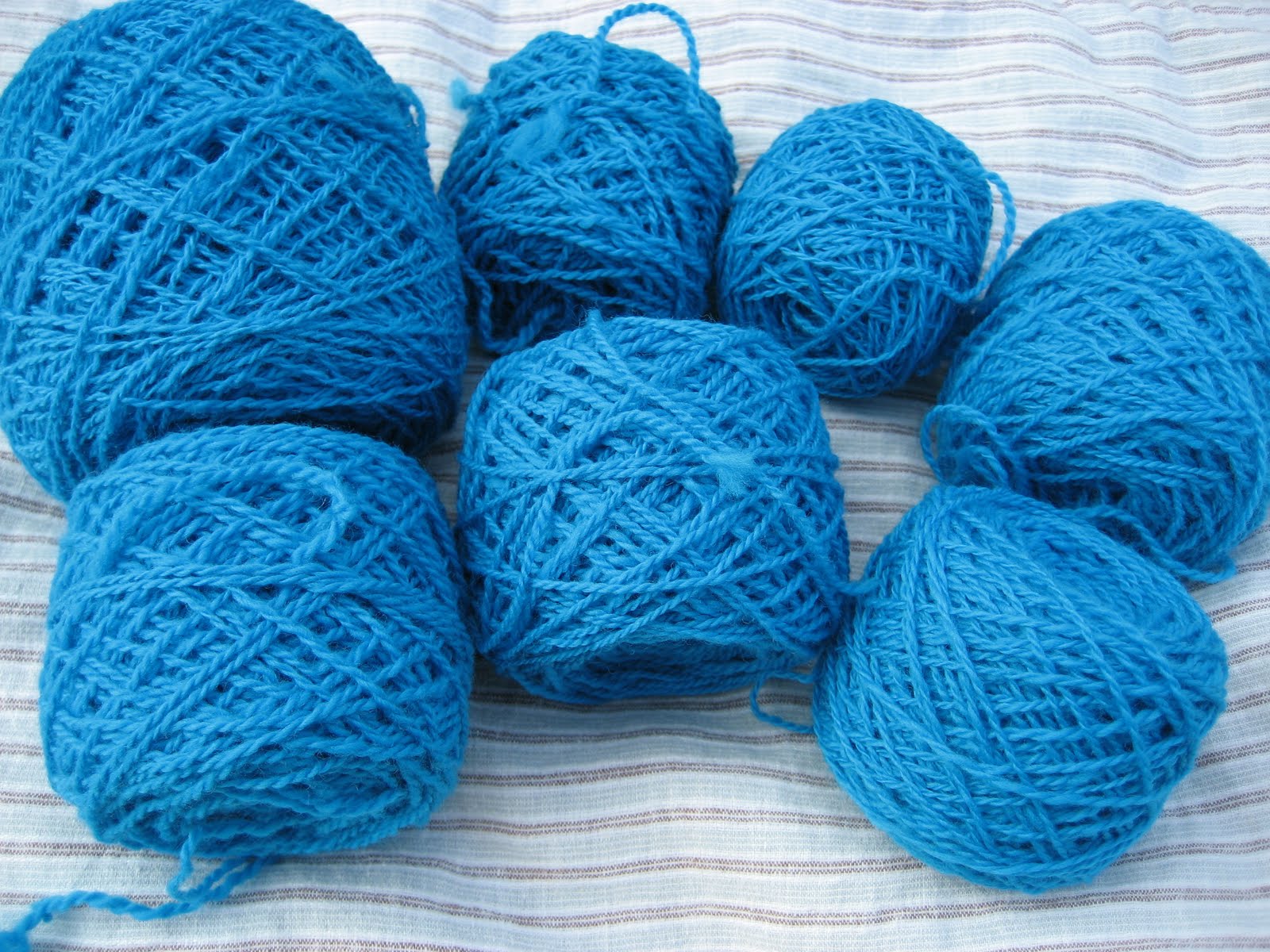
Here are the seventy-sixth and seventy-seventh skeins I've spun. Between them there is a total of 6 1/2 ounces of fiber and 120 yards. The yarn is bulky three ply and the singles were spun to about 16 wpi.
The wool is local wool I bought directly from Lynn Szarabajka of Fish Bowl Farm in Dyke, VA. The wool came from a naturally-coloured Corriedale cross sheep named Latte.
October 26, 2010
Plying Methods
I was asked the other day whether I am able to get skeins of a reasonable size when using Andean plying, where I wrap the singles around my hand in a certain way, slide them down to my wrist, and ply from either end. The person asking the question was getting very small skeins.
I am able to get skeins of a reasonable size with the Andean method. My Andean-plied skeins are normally 1 ounce for thin yarn and 2 ounces for thick yarn. I weigh out the fiber beforehand. The weights are based on the amount I can load onto a spindle before it stops spinning well and begins to get sluggish. Whatever the yardage, I make sure it can be wrapped on my hand by running a chopstick straight up the back of my hand to take the brunt of the yarn's force. Not exactly comfortable, but effective.
I'm sure it would be very tedious to do with cobweb-weight singles, but I don't spin nearly that fine.
I do sometimes spin my two ounces and transfer it to a bobbin, and repeat until I have three loaded bobbins for making three ply. (Andean plying only gives you two ply.) I really need to fill my bobbins with a total of two ounces, the amount that comfortably fits on a spindle, that is, 2/3 of an ounce each bobbin, plus a little extra in case one bobbin's singles are a bit thicker and come up a bit short.
When I have fully loaded bobbins to get through, I have a harder time removing one skein's worth from the spindle and starting another. For an example of the nuttiness that can happen, see this picture of my poor overloaded spindle.
I am able to get skeins of a reasonable size with the Andean method. My Andean-plied skeins are normally 1 ounce for thin yarn and 2 ounces for thick yarn. I weigh out the fiber beforehand. The weights are based on the amount I can load onto a spindle before it stops spinning well and begins to get sluggish. Whatever the yardage, I make sure it can be wrapped on my hand by running a chopstick straight up the back of my hand to take the brunt of the yarn's force. Not exactly comfortable, but effective.
I'm sure it would be very tedious to do with cobweb-weight singles, but I don't spin nearly that fine.
I do sometimes spin my two ounces and transfer it to a bobbin, and repeat until I have three loaded bobbins for making three ply. (Andean plying only gives you two ply.) I really need to fill my bobbins with a total of two ounces, the amount that comfortably fits on a spindle, that is, 2/3 of an ounce each bobbin, plus a little extra in case one bobbin's singles are a bit thicker and come up a bit short.
When I have fully loaded bobbins to get through, I have a harder time removing one skein's worth from the spindle and starting another. For an example of the nuttiness that can happen, see this picture of my poor overloaded spindle.
October 25, 2010
Country Market Demo
All four of us that did the handspinning demonstration at the farmers' market thought it was an enjoyable day out in the country and wished we could do it again.
One of the participants was the natural dyer that I got to see dye with cosmos blossoms and walnuts last week. She was spinning some wool that was dyed yellow with cosmos. She says the cosmos blossoms were enclosed in a net in the dyebath to keep pieces from getting in the fiber. Some pieces got in anyway and she had to pick them out. She also said some of the walnuts she used were immature, so from that I take that their wizened surface must have been from the boiling and not deterioration from age. She plans to steep the walnuts repeatedly, that is, daily to deepen the dyebath's intensity.
We had a traditional Saxony wheel, two upright folding castle wheels, and drop spindles on show along with fiber, skeins, hand cards, and a niddy noddy. I had a selection of open skeins draped across the top corners of a cork board sign. The sign was handlettered with "fresh spun yarn" and our guild name. I put the board on the seat of my folding chair propped up against the back, which put the skeins in easy touching distance for people who came over to watch us spin. They mostly went for the ruby red merino, over the naturally coloured Gulf Coast Native, Targhee, or Corriedale cross. I also had my ball of spun Icelandic thel and some Blue Face Leicester wool top. I talked about which skeins came from Virginia-raised sheep and what different properties in the wool were represented by each sample.
I made the analogy between wool and human hair: curly hair tends to be dull, whereas straight hair tends to be shiny. One person wondered if the curliness or straightness of a sheep's wool changes over time, but no, the structure goes for that sheep and for sheep of that breed. Another person wondered if the relative dullness or lustrous appearance was determined by diet and if shine could be increased by supplementing a sheep's diet. Certainly good feed makes for good wool, but again, the structure is the structure.
One of the participants was the natural dyer that I got to see dye with cosmos blossoms and walnuts last week. She was spinning some wool that was dyed yellow with cosmos. She says the cosmos blossoms were enclosed in a net in the dyebath to keep pieces from getting in the fiber. Some pieces got in anyway and she had to pick them out. She also said some of the walnuts she used were immature, so from that I take that their wizened surface must have been from the boiling and not deterioration from age. She plans to steep the walnuts repeatedly, that is, daily to deepen the dyebath's intensity.
We had a traditional Saxony wheel, two upright folding castle wheels, and drop spindles on show along with fiber, skeins, hand cards, and a niddy noddy. I had a selection of open skeins draped across the top corners of a cork board sign. The sign was handlettered with "fresh spun yarn" and our guild name. I put the board on the seat of my folding chair propped up against the back, which put the skeins in easy touching distance for people who came over to watch us spin. They mostly went for the ruby red merino, over the naturally coloured Gulf Coast Native, Targhee, or Corriedale cross. I also had my ball of spun Icelandic thel and some Blue Face Leicester wool top. I talked about which skeins came from Virginia-raised sheep and what different properties in the wool were represented by each sample.
I made the analogy between wool and human hair: curly hair tends to be dull, whereas straight hair tends to be shiny. One person wondered if the curliness or straightness of a sheep's wool changes over time, but no, the structure goes for that sheep and for sheep of that breed. Another person wondered if the relative dullness or lustrous appearance was determined by diet and if shine could be increased by supplementing a sheep's diet. Certainly good feed makes for good wool, but again, the structure is the structure.
October 23, 2010
Princesses
Hope to go to another handspinning demonstration today.
The last demo I did, yet another mother told yet another young daughter that "back in the old days, you would have had to do this, all five year olds spun yarn for their families."
I'm sure this is accurate, apart from cultures that wore skins or woven, plaited, and twined unspun plant fibers, and I think kids should understand that there are handy skills that were once widespread and part of everyday life.
But I found myself countering with a different message: "back in the old days, princesses spun yarn, and they had beautiful spindles and wool baskets made of precious metals."
This is also accurate, according to Elizabeth Wayland Barber's chapter, "The Golden Spindle," in her book Women's Work: The First 20,000 Years. When you think Helen of Troy, you don't think yarn, but apparently Homer puts her in possession of a golden spindle and a silver wool basket with gold-rimmed wheels. (Why wheels, I ask myself.)
I stressed the princess angle to the girl so that she would associate handspinning more with choice and luxury and less with child-labour and drudgery. Spinning yarn is not drudgery to me. I turn my drop spindle and draft wool because I enjoy doing it. Fleece preparation and dyeing are not my particular joy, but I hear others take pleasure in those tasks as well.
Certainly necessity was a compelling reason to spin back in the old days, but to the typical girl I'm likely to run into who wears mass-produced clothing and watches Disney, I am sure stories of handspinning princesses are much more relevant and captivating.
The last demo I did, yet another mother told yet another young daughter that "back in the old days, you would have had to do this, all five year olds spun yarn for their families."
I'm sure this is accurate, apart from cultures that wore skins or woven, plaited, and twined unspun plant fibers, and I think kids should understand that there are handy skills that were once widespread and part of everyday life.
But I found myself countering with a different message: "back in the old days, princesses spun yarn, and they had beautiful spindles and wool baskets made of precious metals."
This is also accurate, according to Elizabeth Wayland Barber's chapter, "The Golden Spindle," in her book Women's Work: The First 20,000 Years. When you think Helen of Troy, you don't think yarn, but apparently Homer puts her in possession of a golden spindle and a silver wool basket with gold-rimmed wheels. (Why wheels, I ask myself.)
I stressed the princess angle to the girl so that she would associate handspinning more with choice and luxury and less with child-labour and drudgery. Spinning yarn is not drudgery to me. I turn my drop spindle and draft wool because I enjoy doing it. Fleece preparation and dyeing are not my particular joy, but I hear others take pleasure in those tasks as well.
Certainly necessity was a compelling reason to spin back in the old days, but to the typical girl I'm likely to run into who wears mass-produced clothing and watches Disney, I am sure stories of handspinning princesses are much more relevant and captivating.
October 22, 2010
seventy-fourth and seventy-fifth skeins
Here are the seventy-fourth and seventy-fifth skeins that I've spun. They are both in Ashland Bay merino wool top in the colour magenta.
One is spun somewhat erratically. I was talking to people while demonstrating the drop spindle and I don't spin my absolute best when I'm trying to convince strangers they too can do this. I finished up spinning the yarn at home where my hands were chilly, and that made for erratic drafting too.
The second skein is spun with large slubs put in deliberately at regular intervals.
When you start learning how to spin yarn, you make slubs involuntarily. For quite a long time afterward you try very hard not to make any at all.
Given my dedication to gauge and consistent spinning, the slubs above are a departure for me. There is a story behind them.
The same day that I was demonstrating handspinning with the pink wool, I also spent some time with a bit of donated blue wool, showing people how I spin and getting them to try. After spinning in the usual way and chatting with some on-lookers, I impulsively made a large slub to provoke a reaction.
When you do the unexpected, people think more. They have to think in order to reconcile their understanding of the world with the strange new thing that contradicts what they know. I can't remember whether this is Bloom's theory or Piaget's or whose, but I am happy to use it during handspinning demonstrations.
In the long strand above a drop spindle, the introduction of a large slub is very obvious, more so than it would be with a flyer spinning wheel where the yarn is taken up quickly. I got a reaction right away. "Oh, so that's how they make yarn like that," she said, and he said, "Can you fix it?"
You can fix a slub. Put one hand on each side about 1 1/2 inches out from the ends of the slub. Twirl the strand so the slubby section untwists, then tug gently to thin the fiber out. Let go so the twist runs back into the section and give the yarn a titch more spin before you resume spinning.
Anyway, for the seventy-fifth skein, I made slubs on purpose. I've been meaning for a long time to see whether I could spin consistent slubs and what the effect would be.
The yarn will pill with hard use, so I consider it a flash-in-the-pan yarn. I plan to make these skeins into a hat for a friend who enjoys wearing outrageously cute and stylish clothes.
October 21, 2010
October 20, 2010
Watched Flax Being Spun
Got to watch flax being spun.
The flax was prepared by children at a living history museum, so it's coarse and in rough shape.
Note the little pot hanging from the wheel. The pot holds water. The spinner dips fingers in and smoothes the yarn as the fiber is spun. The finish on the spinning wheel protects it from any water damage.
She spun without a distaff, as it was easy to hold the tiny amount of flax each child would bring her.
The flax spinner notes that the quality of her spun flax isn't just determined by the quality of the children's processing. Her spun flax also depends on the quality of the retting job.
Retting, if you'll remember, is rotting the stems to break them down to just the right stage, then drying them. Do it correctly and the woody boon shatters properly when broken, scutched, and hackled. The boon falls away, leaving long, strong strands that can be spun. The method of retting can determine the colour of the fibers, how grey or golden they are.
She says that among handspinners, retting is the area where there is the least knowledge. If you get it wrong, you lose your whole crop. She expects it could take years and many tries to get the knack and have quality flax to spin.
October 19, 2010
Cosmos Blossoms for Yellow Dye
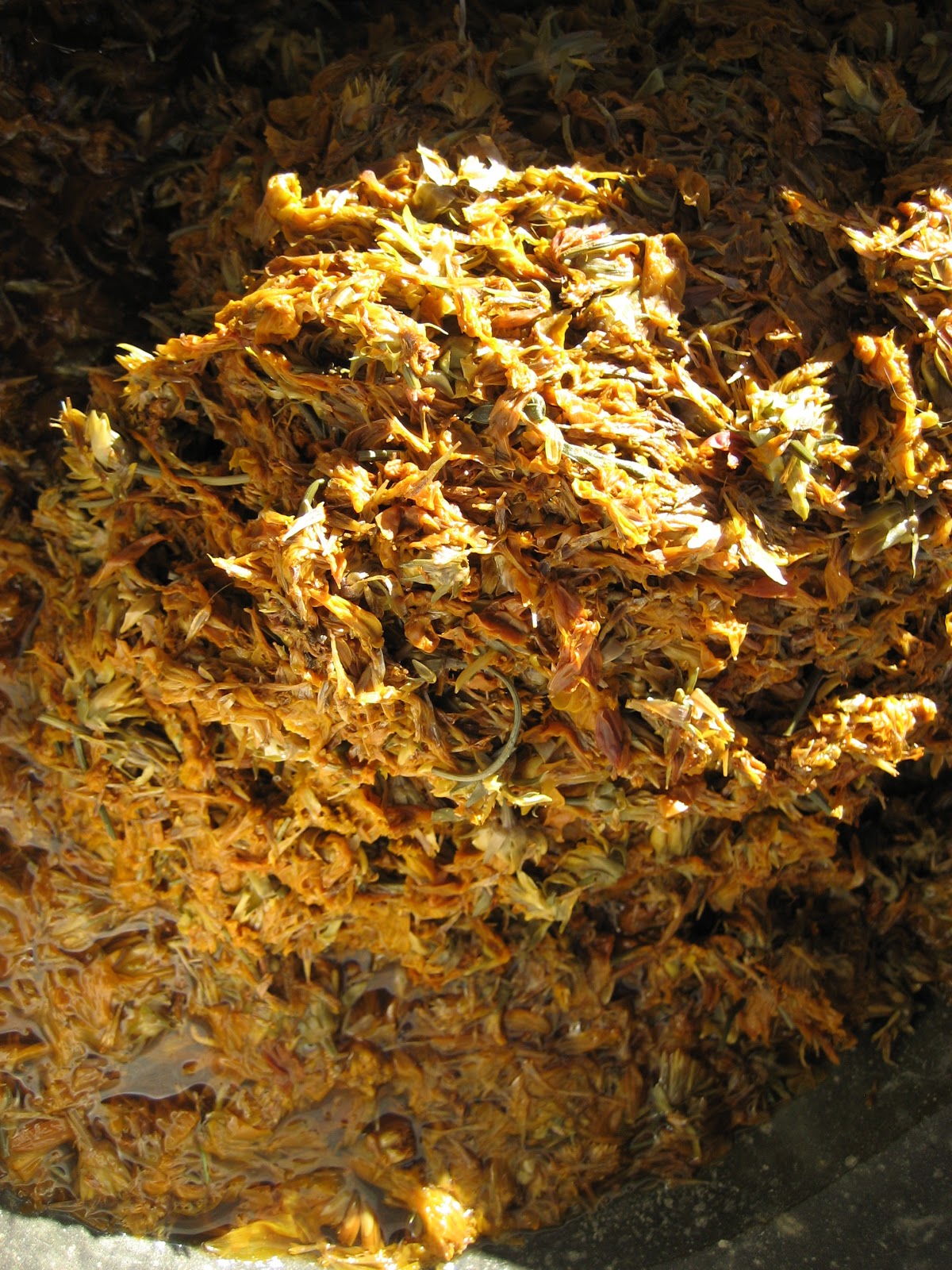
Here are some cosmos blossoms a dyer used to create yellow dye on a silk scarf. The blossoms had been gathered and dried for storage, then steeped to make the dye bath.
Here is the result:
October 18, 2010
Black Walnuts for Brown Dye
Got to see someone dye yarn with a natural black walnut dye. She steeped the entire walnuts, husks and all, in a copper pot over a wood fire. The walnuts are removed with a strainer spoon and the yarn or wool is added.
The colour was pale brown. To intensify the colour, she will add more walnuts. She will keep the dye bath for as long as five years, by skimming the mould, adding more walnuts, and reheating.
The copper pot leaches metal into the water. It acts as a mordant to set the colour and give it a slight green tinge.
I mentioned the tiny bag of black walnut dye powder I saw selling for a large price at the fiber festival. The dyer laughed and said you never need to buy that unless you have no walnut trees.
Sorry the photo is sideways. Also sorry I didn't get a picture of the walnuts. They looked whole; that is, the husks had not split the way walnut husks do when the nut is ready to be gathered for food. They looked dark and wizened not bright green like I'm used to finding walnuts. I couldn't tell if that was because they'd been boiled in the dye bath, or because they'd been on the ground long enough to shrivel up, or because black walnuts look different from English walnuts.
October 16, 2010
Swatching for a Mitten
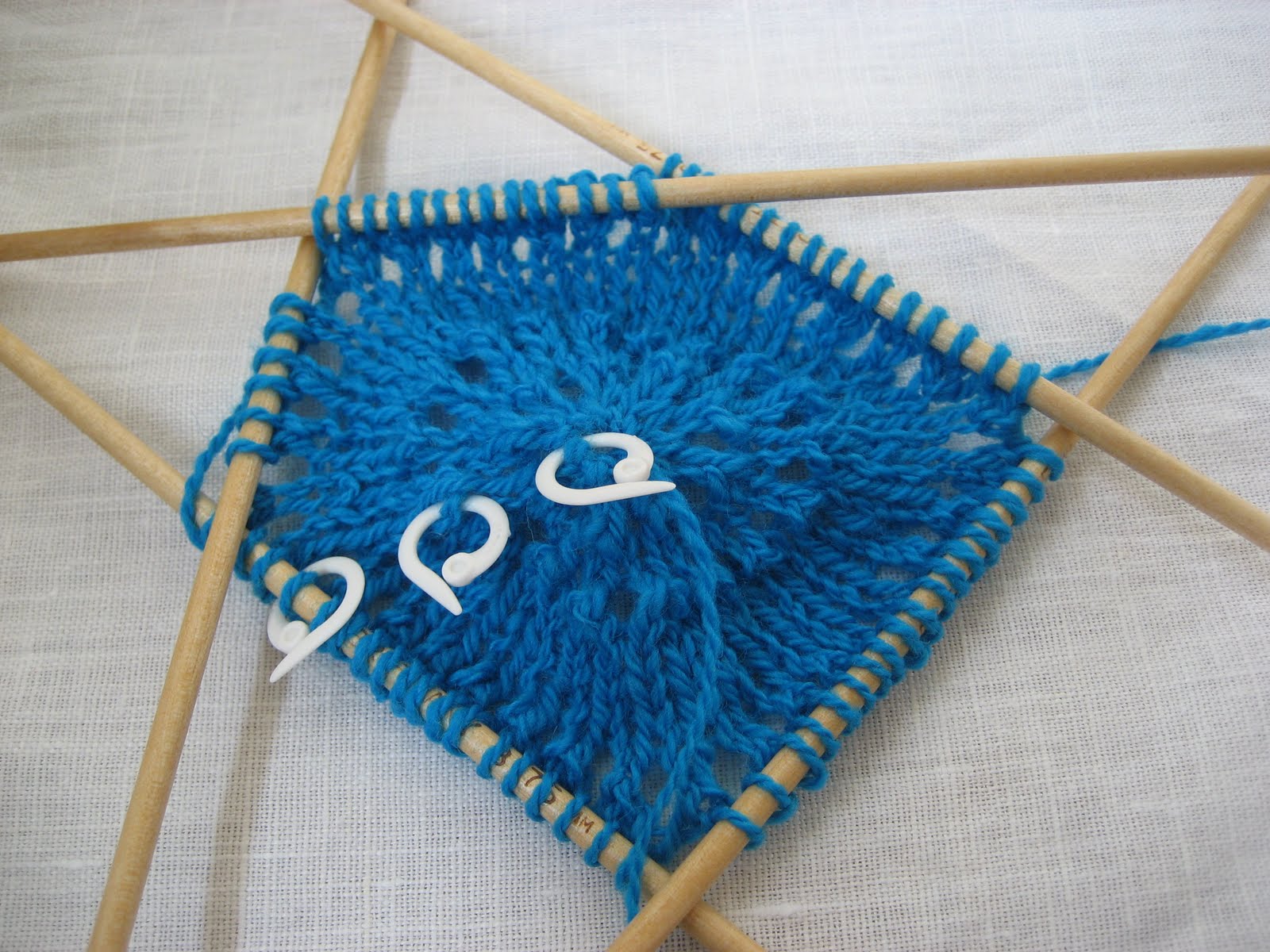
I am hoping to knit this yarn into a mitten. Right now what I have is a malformed swatch that flares out in a very silly way. Too many stitches where I switched from rib to stockinette. Too large a needle for the rib stitches as well.
I had this knitted up once before, trying for a hat, but frogged that too. All part and parcel of handspun's random gauge and my desire to wing it.
October 15, 2010
Resiliency
Resiliency is the ability of a population to deal with shocks to the system. Resiliency means you can harvest wheat and edible chestnuts when the potatoes get blight. It means there are enough reserves to outlast a shortage. It means producers and distributors plan for contingencies and set aside resources to carry out those plans. A resilient system has redundancies and not bottlenecks: many direct sellers or many backyards producing food, for example, so that if one part goes down, the rest carries on.
The last time anyone in my family suffered shocks to the clothing system was in England during the Second World War. A new suit was available for purchase one day, and the next, rationing was declared.
Resiliency sounds like it is about gruesome austerity. Rather, resilient systems prevent enforced austerity. It means you can bounce back from emergencies or radical change and stuff still works to meet your needs.
I would like to say that handspinning promotes resiliency. It certainly has great capacity to do so. I don't know if my handspinning has.
Sure, handspun has theoretically given me new places to get my clothes. I say theoretically because these clothes need some assembly first.
Sure, my equipment purchases have contributed to the income of a number of small independent manufacturers. For the most part, that's who is making the equipment, and buying from them directly has been one of the pleasures of handspinning for me.
Some of my fiber I've bought locally and direct, and I've spun some heritage breed wool. Unfortunately, however, the fiber I like most is Blue Face Leicester (BFL) wool, commonly sold as homogenized anonymous wool top imported from another continent.
I want to look for unprocessed local BFL fleece after I spin what top I have. I plan to examine some local BFL/Border Leicester cross sheep fleeces next month at a shearing day but am uncertain whether the wool will have the same properties as pure BFL.
The last time anyone in my family suffered shocks to the clothing system was in England during the Second World War. A new suit was available for purchase one day, and the next, rationing was declared.
Resiliency sounds like it is about gruesome austerity. Rather, resilient systems prevent enforced austerity. It means you can bounce back from emergencies or radical change and stuff still works to meet your needs.
I would like to say that handspinning promotes resiliency. It certainly has great capacity to do so. I don't know if my handspinning has.
Sure, handspun has theoretically given me new places to get my clothes. I say theoretically because these clothes need some assembly first.
Sure, my equipment purchases have contributed to the income of a number of small independent manufacturers. For the most part, that's who is making the equipment, and buying from them directly has been one of the pleasures of handspinning for me.
Some of my fiber I've bought locally and direct, and I've spun some heritage breed wool. Unfortunately, however, the fiber I like most is Blue Face Leicester (BFL) wool, commonly sold as homogenized anonymous wool top imported from another continent.
I want to look for unprocessed local BFL fleece after I spin what top I have. I plan to examine some local BFL/Border Leicester cross sheep fleeces next month at a shearing day but am uncertain whether the wool will have the same properties as pure BFL.
October 14, 2010
Sovereignty
Food sovereignty is the right of a population to control and determine what they eat. Food sovereignty is at risk, for example, when shipping is interrupted, blight hits the potatoes, or a segment of the population can't afford to buy enough food on an on-going basis. Regional government planning departments are starting to include in official community plans their positions and initiatives addressing the issue of food sovereignty. For example, in the City of Nanaimo's OCP for 2008, food security appears as an objective, specifically increased sustainability, partnerships, and access.
Pretty much no one in the West is worried about clothing sovereignty. We don't see any risks of having an outside party in charge of our clothing's style, fabric content, environmental impact, transportation, pricing, labour practices, manufacturing process and distribution. That's expected.
The last time anyone my family was clothing-insecure was the Great Depression. For one family member, there wasn't enough money to buy new shoes that fit properly.
Handspinning gets me a bit more clothing sovereignty in my life. Or at least it would if I made myself something to keep and wear instead of eternally practicing new skills and giving the pieces away.
Ask handspinners what they like about spinning yarn and I think most will tell you they really enjoy having so much control over their projects, which usually end up as clothes. That, and they would say they really enjoy the physical process of handspinning.
Pretty much no one in the West is worried about clothing sovereignty. We don't see any risks of having an outside party in charge of our clothing's style, fabric content, environmental impact, transportation, pricing, labour practices, manufacturing process and distribution. That's expected.
The last time anyone my family was clothing-insecure was the Great Depression. For one family member, there wasn't enough money to buy new shoes that fit properly.
Handspinning gets me a bit more clothing sovereignty in my life. Or at least it would if I made myself something to keep and wear instead of eternally practicing new skills and giving the pieces away.
Ask handspinners what they like about spinning yarn and I think most will tell you they really enjoy having so much control over their projects, which usually end up as clothes. That, and they would say they really enjoy the physical process of handspinning.
October 13, 2010
Safety, Food, and Fiber
When I consider possible reasons why farmers' markets and relocalization movements are focusing on food rather than clothing, I come to the obvious reason. You have to eat. You have to wear clothes, too, but you're more likely to run out of food first so it's a good idea to make sure your local supply is assured.
In the more mainstream marketplace, supermarkets, people are paying a premium for local food and organic food. I don't think these people care so much about local supply. I think it has to do with fears about safety.
Food safety is a hot topic but no one is worried about clothing safety in a big way. We worry about what we eat, but not what we wear. I mean, we might worry whether we can afford the right clothes, or whether our clothing will protect us from flames and slippery floors, or whether our clothes make us look fat.
But we don't worry that our clothing will harm our health, that we will suffer anything like those poison-dipped cloaks from mythology. Clothing is perceived as a surface issue, outside us, whereas food is an internal matter. (Yes, I am stealing an idea from a Wendell Berry essay here about people's perceptions of the environment as "outside" and "other." At least I think I am. I read that essay a long time ago.) We are what we eat. The modern-day poisons of clothing are far away. Blue jean dye waste chokes rivers in China, for example, not here.
Yet our skin and our lungs absorb. We wear clothing produced and distributed in ways that are highly parallel to the ways conventional, non-organic food production and distribution are done. I think it's worth thinking about.
When I think about it, my mind bounces around and keeps coming back to how limited my options are and how hard I'd have to work to source or create clothes and household textiles that meet standards comparable to certified organic food. (I know there are items out there, thanks, so you don't have to post links for me. I am sure there are even some nice plain organic clothes out there that aren't plastered with symbols I'd refuse to wear for religious reasons.) I haven't got a silver bullet solution, but I continue to think and spin yarn.
In the more mainstream marketplace, supermarkets, people are paying a premium for local food and organic food. I don't think these people care so much about local supply. I think it has to do with fears about safety.
Food safety is a hot topic but no one is worried about clothing safety in a big way. We worry about what we eat, but not what we wear. I mean, we might worry whether we can afford the right clothes, or whether our clothing will protect us from flames and slippery floors, or whether our clothes make us look fat.
But we don't worry that our clothing will harm our health, that we will suffer anything like those poison-dipped cloaks from mythology. Clothing is perceived as a surface issue, outside us, whereas food is an internal matter. (Yes, I am stealing an idea from a Wendell Berry essay here about people's perceptions of the environment as "outside" and "other." At least I think I am. I read that essay a long time ago.) We are what we eat. The modern-day poisons of clothing are far away. Blue jean dye waste chokes rivers in China, for example, not here.
Yet our skin and our lungs absorb. We wear clothing produced and distributed in ways that are highly parallel to the ways conventional, non-organic food production and distribution are done. I think it's worth thinking about.
When I think about it, my mind bounces around and keeps coming back to how limited my options are and how hard I'd have to work to source or create clothes and household textiles that meet standards comparable to certified organic food. (I know there are items out there, thanks, so you don't have to post links for me. I am sure there are even some nice plain organic clothes out there that aren't plastered with symbols I'd refuse to wear for religious reasons.) I haven't got a silver bullet solution, but I continue to think and spin yarn.
October 12, 2010
Alternative Systems
If only we can move beyond the oversimplistic definitions of cheap food, we can change the current system. In practical terms, what this means is shifting shopping patterns to follow three main principles: local, seasonal and direct...Keeping alive alternative systems of distribution is one of the most important things individuals can do in the face of ever-growing retail concentration. That, and ensuring farmers get a fairer share from our shopping so they can survive.The system for food has changed somewhat since Lawrence's book was published in 2004. There is comparatively little sense of urgency out there about changing the system for clothing.
Felicity Lawrence, Not On The Label: What Really Goes Into the Food on Your Plate
There are difficulties in transferring her call to action to clothing.
The alternative systems of distribution for clothing were dismantled and abandoned much earlier and to a greater extent than those for food. It's been a long time since the black sheep made direct sales of wool to the little boy who lives down the lane. Peru is the only place I've heard of that retains a vibrant alternative system of clothing production and sales.
You can argue that in the West there is not nearly the monopolistic control on the sale of clothing as there is on the sale of food (especially after you read in Not On the Label how monopolistic that control is), and I will agree that there are probably more large clothing retailers competing for your dollar than there are large supermarket chains.
Try and see what proportion of your diet you can fill with the 100 mile diet principles, and then try and see if you can be clothed at all on a 100 mile fiber diet. Go to the nearest farm gate and see whether they want to sell you raw materials to stock your pantry or your wardrobe.
Ask how many of your friends have brewed beer at home or tried bread-making or canned some fresh-caught salmon and then ask how many have knit their own mitts. Look at their fishing rods and garden spades, then search their spare rooms for spinning wheels and looms. Challenge them to go to the nearest bank of clay and stand of trees and come back with a drop spindle and warp-weighted loom. Quiz them on the location of the nearest blackberry patch, then ask about the nearest fibre animal or plant.
My guildmate and I were asked at the farmers' market if handspinning was gaining popularity. We weren't sure.
I am spinning yarn and trying to learn to make my own clothes from the fiber up. I consider myself to be a pretty mainstream, conventional person. Alternative, underground scenes only hold my interest in a train-wreck, fleeting sort of way. I am not out to overthrow anything.
I want a resurgence in our capacity to produce and to trade on a peer-to-peer basis. That's the part of capitalism that captures my imagination, the means to control production. My rather idealistic sympathies are with the small independent producer, and in my idealism I lean toward egalitarianism. I would like everyone to be proficient at handspinning and making handspun clothes. Then we'd have a basis for a workable alternative system. Realistically, I just don't think the economic incentive or the cultural mood is there right now.
I've only recently started wanting an alternative system to meet our need for food and clothing. I used to think the conventional system of clothing manufacture and distribution was pretty smart. I thought it met our needs quite well with little trouble. I thought it was the only civilized way to go. I see it differently now. I think the conventional system lacks resiliency, is exploitative, creates a lot of waste, and floods markets, which undermines competition and sovereignty. Even if climate change and Peak Oil doomsayers' dire predictions come to nothing and the clothes keep coming in the ordinary way, there will still be issues and areas where the conventional system fails to meet a lot of needs.
And, yes, thank you, I am aware how many handspun-wearing ancient civilizations were exploitative and monopolistic.
October 11, 2010
Thanksgiving
Happy Thanksgiving!
When you read the verse below, don't think of fifties girdles, think ancient-style card-woven belts.
I have cards, I have a book on how to do card (tablet) weaving, I have a warping board, I probably have suitable handspun sitting around, I just need to get around to trying again.
Hear, O Lord, and be gracious to me;
O Lord, be my helper. You have turned for me my mourning into dancing;
You have loosed my sackcloth and girded me with gladness,
That my soul may sing praise to you and not be silent
O Lord my God, I will give thanks to You forever.
Psalm 30:10-12 NASB
October 09, 2010
Improv
I unexpectedly got to show six people how a spindle works. That was fun. Good thing I had a drop spindle and wool in my bag.
You wouldn't expect handspinning to come up at the tail end of a composting seminar. They were taking questions and I asked, so, ever mulched with waste wool, I hear it's good? And they said, you sound like you know something about wool. Why, yes, I'm a handspinner, let me show you, I said...
I love the old, "what if the wool comes apart" question during demonstrations. I get to theatrically play out what looks like a worst-case scenario then rescue the yarn. "What, you mean like this?" I say as I pull the mass of roving apart with a dramatic flourish. I cry, "oh no!" in mock horror at what I've done, then overlap the fibers' ends and resume spinning.
You wouldn't expect handspinning to come up at the tail end of a composting seminar. They were taking questions and I asked, so, ever mulched with waste wool, I hear it's good? And they said, you sound like you know something about wool. Why, yes, I'm a handspinner, let me show you, I said...
I love the old, "what if the wool comes apart" question during demonstrations. I get to theatrically play out what looks like a worst-case scenario then rescue the yarn. "What, you mean like this?" I say as I pull the mass of roving apart with a dramatic flourish. I cry, "oh no!" in mock horror at what I've done, then overlap the fibers' ends and resume spinning.
October 08, 2010
The Linen Project from Transition Victoria
A Transition Victoria re-skilling working group in Victoria, B.C. is experiencing the process of small-scale flax production for handspinning. I wish I could go see their work, but the closest I can get right now is this link:
http://transitionvictoria.ning.com/photo/albums/the-linen-project
From my reading on flax, I gather that one of the steps, retting flax, takes a great deal of experience and skill to get the microbial action just right, a level of skill on par with brewing beer or making cheese. It's the sort of skill where you'd like to see someone do it first so you can get an idea of how it's done, but because there are so few people who know how it's done, someone has to take the initiative which appears to be the case with the above project.
http://transitionvictoria.ning.com/photo/albums/the-linen-project
From my reading on flax, I gather that one of the steps, retting flax, takes a great deal of experience and skill to get the microbial action just right, a level of skill on par with brewing beer or making cheese. It's the sort of skill where you'd like to see someone do it first so you can get an idea of how it's done, but because there are so few people who know how it's done, someone has to take the initiative which appears to be the case with the above project.
October 07, 2010
Spinning Some Local Wool from My Stash
Here you can see some local wool I'm spinning from my stash. I got it at last year's fiber festival, and the complete revolution of the year propelled me to get my hands on it and spin. Nothing like getting something done after doing nothing about it for ages. Cathartic, really cathartic. Makes you feel like a better person.
So does using local fiber. Revel in the residual grease and that slight scratchiness; it's virtuous stuff. Like hair shirts. (And like carob. See verse below; a locust pod is carob. Somebody was telling me the other day that she finds carob is a tasty alternative to chocolate. Me, I have had a "no carob" policy firmly in place from a very early age and see no reason to change.)
For this is the one referred to by Isaiah the prophet when he said, "The voice of one crying in the wilderness, 'Make ready the way of the Lord, make His paths straight!'" Now John himself had a garment of camel's hair and a leather belt around his waist; and his food was locusts and wild honey. Matthew 3:3, 4 NASB
October 06, 2010
October 05, 2010
I Give You Strauch!
I give you the man who makes Strauch drum carders, Strauch ball winders, and Strauch hand cards: Otto Strauch himself!
Here he is at the fiber festival. You can see a shelf full of Strauch Fiber Equipment wool cards behind him in full and child size. He and his team make fiber tools in Virginia where this fiber festival is held, and he considers local production to be a selling point of his products.
He describes himself as frugal, and offers this frugal tip: remove the stretchy drive band off the Strauch ball winder when not in use to prolong its life.
You'll remember that last year I meant to post my photo of him from the fiber festival but didn't get his image release. Fortunately this year I found he was quite pleased at the prospect of "being on another blog somewhere out there." A customer was happy to be seen on the blog too.
October 04, 2010
seventy-second skein
Ahora les traemos la hilada a mano! (And now we bring you the handspun.) This is the seventy-second skein I've spun.
The 62's wool top, 2 1/2 ounces of it, is from Sweetgrass Wool's Targhee sheep in Montana. I spun the singles to about 24 wpi, then made two ply yarn.
This breed is new to me. I like the wool's white colour. Perhaps it is the texture of the wool that makes the colour so interesting to look at.
Believe the advertising blurbs that use words like "lofty" and "bounce" for Targhee. The wool reminded me of a sample piece of natural latex mattress foam I once got from Savvy Rest. I found that after I spun my Targhee, every little slub expanded and asserted itself, especially after I plied the yarn. Whatever I make out of this yarn is going to look very different from anything I've made so far, not because of the slubs but because of the way the wool puffs out. I'm looking forward to the results.
I spun the skein shortly before the fiber festival's handspun competition submission deadline. You can imagine the charge I got out of discovering that late in the game that spongey-type wools magnify areas of inconsistent spinning. (You can expect inconsistently-spun skeins to place lower in the competition.)
The skein received second place in the drop spindle spun handspun class. The accompanying prize of fiber I got was donated generously by Tintagel Farm.
October 02, 2010
Fiber for Spinning is Not Necessarily WYSIWYG
Fiber for spinning is not necessarily WYSIWYG (What You See is What You Get). I think the fiber in the picture looks quite different spun and unspun. I need to keep this in mind as I window shop at the fiber festival this weekend.
What handspun handknit will I be wearing at the festival? This rather ridiculous, over the top cowl:
October 01, 2010
seventy-first skein
I blogged about handspinning through the entire month of September without posting a single new finished skein of handspun. I didn't want to mention what I spun for the festival competition and I didn't complete much altogether.
But now, I give you my seventy-first skein. It's big. It's actually in three skeins but I think of it as one. The content is a Louet blend of merino and silk, spun three ply and bulky. There's most of a bag there. This is what I plied when I was messing around with the lazy Kate. Spun on a spindle, then transferred the singles to bobbins for plying and from there back on to the spindle.
I hadn't spun bulky for a while. The yardage came out very low, about 80 yards if memory serves. It was fun to spin and use up a large amount of fiber quickly. I regret a little that I didn't eke it out into thinner yarn that would go farther when knitting. By that I don't mean I want to spend a lot of time knitting because I don't, but a thick yarn doesn't create as much fabric or coverage.
September 30, 2010
The Festival Approaches
Procrastination...allows us to believe temporarily that we have nothing to do.
-Monica Ramirez Basco, The Procrastinator's Guide to Getting Things DoneThe fiber festival is very soon. It's getting rather hard to believe that I don't have to do anything yet to get ready.
September 29, 2010
Tilting the Kate
Got around to doing my "tilt the Kate" experiment. Loaded up the bobbins, clamped the lazy Kate to the table on a forty-five degree angle, and plied my yarn. No improvement in performance that I could tell. Running the strands through the back of a chair helped to get proper tension.
You can get lazy Kates that hold the bobbins at a forty-five degree angle with no propping or clamping necessary. A friend got a model called Kate 45 from cjkoho on Etsy and loves it.
September 28, 2010
Replenishing the Kate's Bobbins
I bought a bobbin. I wanted one to wrap with spindle-spun yarn and put on my lazy Kate to help me spin three ply yarn. Three ply is a different construction from two ply, and a year has passed since I've done any.
I like things to coordinate, and I was wondering how I was going to be able to coordinate the new bobbin with the two used bobbins that came with the second-hand Kate.
I would like to claim that my brain didn't need a prod, but it did. Online, I saw a photo of an Ashford-compatible bobbin and realized that the bobbins on my Ashford vertical Kate were probably standard Ashford bobbins.
So I bought an Ashford standard bobbin, and if it doesn't match exactly at least it coordinates. It is the lighter-coloured one in the picture above. Its length is greater but the bushings are set in, making the bobbin about equal with the others. I expect that if I ever rent the guild's Ashford Traditional spinning wheel, I could use these bobbins on it.
No hurry, though.
September 27, 2010
Jiggety Jig
So I went to the farmers' market and came home again, pleased with the way the handspinning demonstration went.
It was me and another member of our guild, who brought lovely samples of fiber and knitted handspun articles. The samples, set out on the table kindly provided by the market, worked very well to promote interaction with shoppers: they would linger, touch the items, take a brochure, and ask questions. I put half the festival brochures on the empty seat of my folding chair and put half the brochures on the table; the brochures on the table got taken. Best to put things right at peoples' fingertips.
I think it helped to have the table off to the side. People could get close to the display without feeling they were under scrutiny, and they could also get close to us because we weren't behind a table. Not that any spinner doing a demonstration would sit behind a table, that would obscure the wheel or spindle.
The amount of discussion, counting both the number of people who talked to us and the length of time they spent, was easily more than that of the last three demonstrations I've done combined.
It's always the uncomfortable moments you remember. There were some questions for which I would have liked to have better answers. For example, do we sell handspun, and what advantage does handspun have over commercial yarn.
We don't sell handspun. Like most handspinners we know, we spin for our own use. In general the amount of labour embodied in a skein of handspun makes their sale rare. You're much more likely to see sales of commercially prepared roving or commercially spun yarn dyed by indie dyers where the profit margin (we assume) is better. I'm sure this is a rather unsatisfactory answer to someone who knits and hopes to pick up a bit of yarn at a market. And I feel bad for alarming someone by telling them how high a measly 3 ounce skein of handspun gets priced on consignment at a local yarn store. I should have made sure to say we handspinners can buy a pound of undyed wool to spin for the same price; the difference is labour and overhead.
We talked about handspun giving us yarn with superior properties, for example the way long-staple wool gives yarn that doesn't pill as readily as short staple wool does. I remembered afterward that you can buy long-staple commercial yarn such as Blue Face Leicester, so perhaps we overstressed that aspect of handspun. I forgot to mention a handspinner's ability to create structure in yarn that isn't available in commercial yarn, such as energized singles for woven collapse fabrics and knitted bias fabrics or yarn made with five strands of singles for knitting high-relief cables.
The question kind of stymied me because there are so many benefits of handspun that have nothing to do with the structural properties of the yarn. In the few days before the demonstration, I wrote a pamphlet about handspinning's benefits and how to learn to spin yarn. I never did distribute it, because my computer printer broke a while back and never got replaced, and I didn't get out to a shop to get copies done in time. Fortunately writing and rewriting the pamphlet's points helped me rehearse what I wanted to say at the demonstration. Talking to someone who only wanted to know how knitting with handspun would be better, I went blank and felt it would be trite and irrelevant to speak of handspun's environmental or sustainable virtues, or handspun's traditional role in resiliency and independence movements, or the pleasure of handspinning as an end in itself.
I felt a bit at sea when thinking about the vendors at the market and what I could tell them about the incredible market handspinners represent. (A beef vendor asked for recommendations about sheep. Shoppers asked if we had sheep. Regrettably, we are not the people to ask about shepherding, though some of our guild members are.) We handspinners buy fiber, dyestuffs, and tools. We are used to buying our equipment and supplies directly, locally, and seasonally so we are probably the kind of customers a market vendor would like. I would like to promote local production of handspinning supplies on the vendors' side as well as local production of clothes on the handspinners' side, but I hesitate. I cannot promise that we handspinners would buy if the vendors bought sheep to shear or planted woad. We source from all over, we have high standards, and a lot of us have enough supplies to keep us spinning yarn for a long time without buying more.
I almost ran through the whole 2 1/3 ounces of local wool I brought with me to spin at the farmers' market. That really caught me off guard. I'm used to estimating the rate at which I go through fiber based on how I spin for thinner yarn, but thicker yarn uses up fiber more quickly. On a related note, one more question I think I answered incompletely was how long handspinning takes. That is a very common question, and the proper answer is the time you spend spinning depends on what you are making and how, but I should have held up my drop spindle and showed how much I had spun since the market opened.
The best question we got was, "I want to spin yarn, what do I do?" We got asked this quite a lot, which was great. We answered, come to the fiber festival next weekend, come to our guild, ask this local yarn shop and that parks and recreation department about lessons, and search for handspinning videos online. A couple of people told us they had a wheel or spindles at home but hadn't gained proficiency yet on their own.
It was me and another member of our guild, who brought lovely samples of fiber and knitted handspun articles. The samples, set out on the table kindly provided by the market, worked very well to promote interaction with shoppers: they would linger, touch the items, take a brochure, and ask questions. I put half the festival brochures on the empty seat of my folding chair and put half the brochures on the table; the brochures on the table got taken. Best to put things right at peoples' fingertips.
I think it helped to have the table off to the side. People could get close to the display without feeling they were under scrutiny, and they could also get close to us because we weren't behind a table. Not that any spinner doing a demonstration would sit behind a table, that would obscure the wheel or spindle.
The amount of discussion, counting both the number of people who talked to us and the length of time they spent, was easily more than that of the last three demonstrations I've done combined.
It's always the uncomfortable moments you remember. There were some questions for which I would have liked to have better answers. For example, do we sell handspun, and what advantage does handspun have over commercial yarn.
We don't sell handspun. Like most handspinners we know, we spin for our own use. In general the amount of labour embodied in a skein of handspun makes their sale rare. You're much more likely to see sales of commercially prepared roving or commercially spun yarn dyed by indie dyers where the profit margin (we assume) is better. I'm sure this is a rather unsatisfactory answer to someone who knits and hopes to pick up a bit of yarn at a market. And I feel bad for alarming someone by telling them how high a measly 3 ounce skein of handspun gets priced on consignment at a local yarn store. I should have made sure to say we handspinners can buy a pound of undyed wool to spin for the same price; the difference is labour and overhead.
We talked about handspun giving us yarn with superior properties, for example the way long-staple wool gives yarn that doesn't pill as readily as short staple wool does. I remembered afterward that you can buy long-staple commercial yarn such as Blue Face Leicester, so perhaps we overstressed that aspect of handspun. I forgot to mention a handspinner's ability to create structure in yarn that isn't available in commercial yarn, such as energized singles for woven collapse fabrics and knitted bias fabrics or yarn made with five strands of singles for knitting high-relief cables.
The question kind of stymied me because there are so many benefits of handspun that have nothing to do with the structural properties of the yarn. In the few days before the demonstration, I wrote a pamphlet about handspinning's benefits and how to learn to spin yarn. I never did distribute it, because my computer printer broke a while back and never got replaced, and I didn't get out to a shop to get copies done in time. Fortunately writing and rewriting the pamphlet's points helped me rehearse what I wanted to say at the demonstration. Talking to someone who only wanted to know how knitting with handspun would be better, I went blank and felt it would be trite and irrelevant to speak of handspun's environmental or sustainable virtues, or handspun's traditional role in resiliency and independence movements, or the pleasure of handspinning as an end in itself.
I felt a bit at sea when thinking about the vendors at the market and what I could tell them about the incredible market handspinners represent. (A beef vendor asked for recommendations about sheep. Shoppers asked if we had sheep. Regrettably, we are not the people to ask about shepherding, though some of our guild members are.) We handspinners buy fiber, dyestuffs, and tools. We are used to buying our equipment and supplies directly, locally, and seasonally so we are probably the kind of customers a market vendor would like. I would like to promote local production of handspinning supplies on the vendors' side as well as local production of clothes on the handspinners' side, but I hesitate. I cannot promise that we handspinners would buy if the vendors bought sheep to shear or planted woad. We source from all over, we have high standards, and a lot of us have enough supplies to keep us spinning yarn for a long time without buying more.
I almost ran through the whole 2 1/3 ounces of local wool I brought with me to spin at the farmers' market. That really caught me off guard. I'm used to estimating the rate at which I go through fiber based on how I spin for thinner yarn, but thicker yarn uses up fiber more quickly. On a related note, one more question I think I answered incompletely was how long handspinning takes. That is a very common question, and the proper answer is the time you spend spinning depends on what you are making and how, but I should have held up my drop spindle and showed how much I had spun since the market opened.
The best question we got was, "I want to spin yarn, what do I do?" We got asked this quite a lot, which was great. We answered, come to the fiber festival next weekend, come to our guild, ask this local yarn shop and that parks and recreation department about lessons, and search for handspinning videos online. A couple of people told us they had a wheel or spindles at home but hadn't gained proficiency yet on their own.
September 25, 2010
To Market, To Market
Off I go to the farmers' market to demonstrate handspinning.
I was thinking of bringing an attention-getting pink wool, but merino felts instead of drafting in hot weather.
Probably a slick fiber like Blue Face Leicester wool or silk would be suitable, but instead I am going to choose a crunchy local wool roving to bring along.
This local wool is what I'm working on at the moment. I am spinning it at a fast pace without worrying too much about consistency, so whatever I spin while distracted and talking to people will match what I've already got.
If you were wondering what I've been occupied with when I should be working on something handspun to wear to the upcoming festival, this local wool is the culprit.
I was thinking of bringing an attention-getting pink wool, but merino felts instead of drafting in hot weather.
Probably a slick fiber like Blue Face Leicester wool or silk would be suitable, but instead I am going to choose a crunchy local wool roving to bring along.
This local wool is what I'm working on at the moment. I am spinning it at a fast pace without worrying too much about consistency, so whatever I spin while distracted and talking to people will match what I've already got.
If you were wondering what I've been occupied with when I should be working on something handspun to wear to the upcoming festival, this local wool is the culprit.
September 24, 2010
Thrift Store Child's Loom
A friend of mine mentioned that she wants her young daughter to weave on a simple cardboard loom the way she did as a child.
A Harrisville Lap Loom, in the original box, was half-hidden on the floor under a clothes rack at the thrift store, complete except for shuttle and yarn. Four dollars. Retail, new, fifty dollars.
So, not only a pretty good find, but a timely one.
September 23, 2010
Still Nothing to Wear
Happy Autumnal Equinox!
Temperatures here are still so hot, I have lost enthusiasm for my plan to wear something handspun at the fast-approaching fiber festival. This means I haven't made anything, either.
I still want to have something on me to signal that I am a handspinner so that people can spot me at fifty paces and ask me about spinning.
The goal has an inherent difficulty. How do you make something that looks obviously handspun? Spin yarn with a slew of slubs? I want to look like I spin yarn; I do not want to look as though I spin badly.
Knitters wear knitted sweaters, weavers wear woven scarves, inkle weavers wear woven belts, felted-fabric felters carry felted purses, and rug hookers carry hooked tote bags but a handspinner could be any of these and be almost undetectable. It's comparable to my experience of being a Canadian expat in the States.
The easy answer to establishing my credibility at the festival is to spin with my drop spindle while I'm there, of course, and I plan to do that. However, I know that some of the time my hands will be occupied with Carpe Donut mostly-organic donuts and such.
Temperatures here are still so hot, I have lost enthusiasm for my plan to wear something handspun at the fast-approaching fiber festival. This means I haven't made anything, either.
I still want to have something on me to signal that I am a handspinner so that people can spot me at fifty paces and ask me about spinning.
The goal has an inherent difficulty. How do you make something that looks obviously handspun? Spin yarn with a slew of slubs? I want to look like I spin yarn; I do not want to look as though I spin badly.
Knitters wear knitted sweaters, weavers wear woven scarves, inkle weavers wear woven belts, felted-fabric felters carry felted purses, and rug hookers carry hooked tote bags but a handspinner could be any of these and be almost undetectable. It's comparable to my experience of being a Canadian expat in the States.
The easy answer to establishing my credibility at the festival is to spin with my drop spindle while I'm there, of course, and I plan to do that. However, I know that some of the time my hands will be occupied with Carpe Donut mostly-organic donuts and such.
September 22, 2010
The Creative Type
The more I spend time with handspinners and spin, the less I see handspinning as creative, and more I see handspun as the result of acquired skill and regular practice.
None of my seventy skeins of handspun yarn are creative in the sense of being innovative or original. A lot are duplicates of each other, where I plowed through the fiber trying to be consistent and repeat my work. Call me productive, not creative.
I make handspun, and I suppose I create yarn out of fluffy fiber.
I still say almost anyone can learn how to spin yarn if they get a mentor and put in the work to learn the steps.
Hopefully, if I say so enough and spin enough and go "Yum, yum," the way a parent does over a toddler's bowl of peas, some uncreative type will try.
None of my seventy skeins of handspun yarn are creative in the sense of being innovative or original. A lot are duplicates of each other, where I plowed through the fiber trying to be consistent and repeat my work. Call me productive, not creative.
I make handspun, and I suppose I create yarn out of fluffy fiber.
I still say almost anyone can learn how to spin yarn if they get a mentor and put in the work to learn the steps.
Hopefully, if I say so enough and spin enough and go "Yum, yum," the way a parent does over a toddler's bowl of peas, some uncreative type will try.
By faith we understand that the worlds were prepared by the word of God, so that what is seen was not made out of things which are visible. Hebrews 11:3 NASB
September 21, 2010
The Scarf Gets Longer
I give you proof the scarf is getting longer.
In other news, I have been spinning and leaving a lot of projects half-spun or half-knit the last little while.
September 20, 2010
SIP Handspun Bracelets Were Better in Theory
I was out spinning in public yesterday afternoon at an agricultural-type festival with some of my guildmates at the Hope of Glory Farm tent.
I think my favourite moment was when a small boy went by. He looked uncomfortable and upset about something and he was grousing to his parents who were in the lead going down the path, but he turned back to watch my spindle spin.
A young woman thought the spindle in motion was "awesome!" and to reward her enthusiasm I handed her a brochure for the upcoming fiber festival. I gave a brochure to a couple of young men who wanted to know, "What are you doing?" They laughed when I put down my magenta wool and showed them the olive drab wool to prove spinning didn't have to be all pink stuff.
People didn't reach down to the pile and take brochures at all. Most were walking along at a pretty good clip going somewhere. The brochures are subtle and probably take more time to scan than a perambulating person has.
Some handspinners that have long experience spinning in public have told me they make handspun bracelets for children. I made half a dozen, and gave them out. I put in fisherman's knots so the bracelet would be adjustable in size, and the knots took a lot of time to do. Also, I did each bracelet individually and because of the way I start my yarn, that meant I had to create a leader each time. I was drafting out the wool and catching it in the spindle's hook while standing with no lap to rest the spindle in, and the result was uncharacteristically lumpy yarn. I was making so few bracelets, stopping and starting so much, and making such poor yarn that I gave up and spun as normal. It made no sense for so many people to pass by me and only see me fiddling with leaders and knots.
I think my favourite moment was when a small boy went by. He looked uncomfortable and upset about something and he was grousing to his parents who were in the lead going down the path, but he turned back to watch my spindle spin.
A young woman thought the spindle in motion was "awesome!" and to reward her enthusiasm I handed her a brochure for the upcoming fiber festival. I gave a brochure to a couple of young men who wanted to know, "What are you doing?" They laughed when I put down my magenta wool and showed them the olive drab wool to prove spinning didn't have to be all pink stuff.
People didn't reach down to the pile and take brochures at all. Most were walking along at a pretty good clip going somewhere. The brochures are subtle and probably take more time to scan than a perambulating person has.
Some handspinners that have long experience spinning in public have told me they make handspun bracelets for children. I made half a dozen, and gave them out. I put in fisherman's knots so the bracelet would be adjustable in size, and the knots took a lot of time to do. Also, I did each bracelet individually and because of the way I start my yarn, that meant I had to create a leader each time. I was drafting out the wool and catching it in the spindle's hook while standing with no lap to rest the spindle in, and the result was uncharacteristically lumpy yarn. I was making so few bracelets, stopping and starting so much, and making such poor yarn that I gave up and spun as normal. It made no sense for so many people to pass by me and only see me fiddling with leaders and knots.
September 18, 2010
Handspinners On Public Display
Handspun is not an impenetrable mystery formed secretly at midnight in the light of the moon by initiates in hoods. Well, maybe for those who like that sort of thing.
Happy World Wide Spin in Public Day!
September 17, 2010
Finished Objects
Sometimes all people want from my blog is to see what I've made.
Click on one of these, to see either handspun yarn or handspun handknit items:
thesojourningspinner.blogspot.com/search/label/I*spun*this
or
thesojourningspinner.blogspot.com/search/label/I*knit*this
Once you scroll to the bottom of the page, hit "older posts" and you'll see more.
ETA:
thesojourningspinner.blogspot.com/search/label/I*wove*this
thesojourningspinner.blogspot.com/search/label/I*made*this*sprang*cloth
Click on one of these, to see either handspun yarn or handspun handknit items:
thesojourningspinner.blogspot.com/search/label/I*spun*this
or
thesojourningspinner.blogspot.com/search/label/I*knit*this
Once you scroll to the bottom of the page, hit "older posts" and you'll see more.
ETA:
thesojourningspinner.blogspot.com/search/label/I*wove*this
thesojourningspinner.blogspot.com/search/label/I*made*this*sprang*cloth
September 16, 2010
Using an RSS feed reader
If you like my blog but forget to read it, consider using an RSS feed reader. RSS stands for Really Simple Syndication. A feed reader checks online sites for you, gathers new content, and puts it in a list. When you read the content, the content goes away.
An RSS feed reader relieves you of having to keep track mentally of what you have and have not read, and it saves you time because you don't have to continually revisit multiple sites.
I use an RSS reader to get updates whenever my favourite Etsy sellers list new fiber and tools. I also use it for blogs, a knitting podcast, and some online forum discussions about handspinning that I want to follow.
You should know that in exchange for this convenience, I give away some of my privacy, since the feed reader knows what I read and when I read it. The one I use analyses the content of my RSS feed subscriptions and then makes recommendations for new feeds, overt evidence of data mining which I find a little disconcerting.
I'll leave you with a quote from Stephen Baker in the October 21, 2008 CBC online article, "Mining for Data"
An RSS feed reader relieves you of having to keep track mentally of what you have and have not read, and it saves you time because you don't have to continually revisit multiple sites.
I use an RSS reader to get updates whenever my favourite Etsy sellers list new fiber and tools. I also use it for blogs, a knitting podcast, and some online forum discussions about handspinning that I want to follow.
You should know that in exchange for this convenience, I give away some of my privacy, since the feed reader knows what I read and when I read it. The one I use analyses the content of my RSS feed subscriptions and then makes recommendations for new feeds, overt evidence of data mining which I find a little disconcerting.
I'll leave you with a quote from Stephen Baker in the October 21, 2008 CBC online article, "Mining for Data"
Society is moving in such a way that it [privacy] is going to become increasingly inconvenient. Like, try to find a pay phone in Vancouver. There are not too many anymore. Or if you want to throw quarters into the [electronic toll booth] every year there is one less tollbooth for you. So you've got all the losers lining up to throw their quarters in the machine and all the people that are free and easy with their data just zipping past.
I think we talk a lot about privacy and people complain about it and fret about it, but at least in this country and I'm not sure about Canada, when given a choice between privacy and monetary savings, they go for the savings every time. And given a choice between privacy and convenience, they go for convenience. And given a choice between privacy and the promise of security, they go for the promise of security.
September 15, 2010
Refurbishing the Kate
I refurbished my second-hand Ashford lazy Kate by replacing the make-shift pins with real manufacturer's parts.
So nice to have fixed it. Somehow when an item is cobbled together and functional but isn't quite right, it preys on the mind. I came across the replacement parts by chance on the Woodland Woolworks site.
I don't use the lazy Kate very often, because Andean plying is more comfortable, but the next time I do use it I will try clamping it so that the bobbins sit at a 45 degree angle. I want to see if that acts to give them some drag and improves my ability to manage the strands.
So nice to have fixed it. Somehow when an item is cobbled together and functional but isn't quite right, it preys on the mind. I came across the replacement parts by chance on the Woodland Woolworks site.
I don't use the lazy Kate very often, because Andean plying is more comfortable, but the next time I do use it I will try clamping it so that the bobbins sit at a 45 degree angle. I want to see if that acts to give them some drag and improves my ability to manage the strands.
September 14, 2010
Fourchettes
I was trying to think what else I found in The Principles of Knitting that looked fantastic, besides the embossed exchange motif. Now I remember: fourchettes, which are diamond-shaped gussets.
Whenever I get around to making my first pair of mittens, mark my words, there will be fourchettes involved even if I have to insert them into the pattern.
September 13, 2010
Industrial and Non-Industrial Design
The movie Objectified is about industrial design's impact on people. I found a great deal of the discussion to be relevant to non-industrial fiber design.
What I want to do is to be able have things that don't exist. You know, things that you can't go out and buy. Or things that irritate you. Anger or dissatisfaction at the very least play such an important role in motivating you to sort of do what we do.
-Marc Newson
Industrial design has been so closely tied to industry and working within the constraints set by industry. Very quickly you come to the edges of the spectrum of choice, the official choice about what kinds of things that companies that produce these products believe people want. We know people want a lot more interesting things but so far we haven't managed to cross that gap.
-Anthony Dunne
September 11, 2010
Handspun is Not Exactly Like Food
I have been going on about how fiber is like food in many ways. However, in some ways it's not.
I don't feel guilty for leaving shelf-stable food unused for months, and I don't tell myself I should really use the items up. With wool, I do.
When I share lavender-flavoured brownies, no one offers me money to make an extra pan. For some reason, handspun hats are different.
I don't feel guilty for leaving shelf-stable food unused for months, and I don't tell myself I should really use the items up. With wool, I do.
When I share lavender-flavoured brownies, no one offers me money to make an extra pan. For some reason, handspun hats are different.
September 10, 2010
Handspun's Like Food: Selling the Idea
As I said, I'm going to put on a handspinning demonstration at a farmer's market along with any guild members who can join me.
I am thinking of putting up a sign like regular vendors use to list products and prices. My list would say,
I have seen all of the above fibers raised or gathered by fellow guild members. The Virginia-grown flax, kudzu, and silk, those I don't think I've actually seen spun.
I am thinking of putting up a sign like regular vendors use to list products and prices. My list would say,
Fresh SpunI am not selling any of these. I am giving out pamphlets about our guild and the upcoming fiber festival. Do you think people will be confused?
Virginia-Raised
silk
cotton
wool
kudzu
alpaca
mohair goat hair
angora bunny
flax
I have seen all of the above fibers raised or gathered by fellow guild members. The Virginia-grown flax, kudzu, and silk, those I don't think I've actually seen spun.
September 09, 2010
Handspun's Like Food: No Clear Definition of Local
Slap the label "local" on food and you have a selling point. Grocery stores are putting up signs next to their locally-sourced products, complete with the name of the farm or how many miles the food travelled.
There are legally-enforced standards for organic, but not for local. This works for an ear of corn, but what about your local chocolate bar-maker or coffee bean roasting company? Their ingredients are imported, but the processing is local. Do they count? Not that I am against local chocolate or anything.
If local clothing ever gets going the way local food is, we could benefit from a public discussion and consensus on what constitutes a local product, and to what degree something is local.
I have seen Romney wool and Icelandic wool for handspinning that have never left their province or state, Shetland wool that was raised in one place and sent on a round trip of hundreds of miles for processing into roving, and Gulf Coast Native wool and mixed-breed wool that have never left the county or regional district. I've handled merino, silk, Bond wool, Scottish Black Face, Navajo Churro, and Blue Face Leicester wool that came from other provinces, other states, and other countries. I have seen fiber whose origins are a complete mystery as well as angora fiber raised in someone's suburban back yard traceable to the actual animal of origin.
You'd think the Bond wool I saw would have been from Australia, but it was raised in the U.S.A., as was the Shetland, which came from purebred stock originating on the U.K.'s Shetland islands. The bit of Scottish Black Face was truly from Scotland, and I can't remember if the Navajo Churro came from the U.S.'s Southwest or not.
Anyway, wherever fiber comes from, it allows a particular degree of transparency for the way it was raised, a level of carbon footprint, a connection to the producer, and a boost to the local economy or to the barter economy or gift economy. I think it would be valuable for those qualities to be reflected when we talk about local fiber, which usually lends itself to all of these.
Another positive point about local products is that they can become distinctive and representative of a locality. There are many regional food examples in Peter Mayle's book French Lessons: Adventures with Knife, Fork, and Corkscrew. Once a local specialty is established as valuable, profiteers are going to try to adulterate the product or try to pass off inauthentic copies. So, a definition of local is needed.
There are legally-enforced standards for organic, but not for local. This works for an ear of corn, but what about your local chocolate bar-maker or coffee bean roasting company? Their ingredients are imported, but the processing is local. Do they count? Not that I am against local chocolate or anything.
If local clothing ever gets going the way local food is, we could benefit from a public discussion and consensus on what constitutes a local product, and to what degree something is local.
I have seen Romney wool and Icelandic wool for handspinning that have never left their province or state, Shetland wool that was raised in one place and sent on a round trip of hundreds of miles for processing into roving, and Gulf Coast Native wool and mixed-breed wool that have never left the county or regional district. I've handled merino, silk, Bond wool, Scottish Black Face, Navajo Churro, and Blue Face Leicester wool that came from other provinces, other states, and other countries. I have seen fiber whose origins are a complete mystery as well as angora fiber raised in someone's suburban back yard traceable to the actual animal of origin.
You'd think the Bond wool I saw would have been from Australia, but it was raised in the U.S.A., as was the Shetland, which came from purebred stock originating on the U.K.'s Shetland islands. The bit of Scottish Black Face was truly from Scotland, and I can't remember if the Navajo Churro came from the U.S.'s Southwest or not.
Anyway, wherever fiber comes from, it allows a particular degree of transparency for the way it was raised, a level of carbon footprint, a connection to the producer, and a boost to the local economy or to the barter economy or gift economy. I think it would be valuable for those qualities to be reflected when we talk about local fiber, which usually lends itself to all of these.
Another positive point about local products is that they can become distinctive and representative of a locality. There are many regional food examples in Peter Mayle's book French Lessons: Adventures with Knife, Fork, and Corkscrew. Once a local specialty is established as valuable, profiteers are going to try to adulterate the product or try to pass off inauthentic copies. So, a definition of local is needed.
September 08, 2010
Handspun's Like Food, Apart from Being Unobtainable
I am going to try to sell customers at a farmers' market on the idea of handspinning, but I keep bumping into the problem of accessibility.
With food, at the farmers' market the food is right there. Quite a lot of it is even prepared for you, like jam or bread or sausage. With the food that is unprocessed, even a lot of that can be eaten out of hand, like carrots or apples. The food is accessible.
With handspun, there's a gap.
Even if shepherds did come to a farmers' market with their wool, which they don't often do, you can't just drape a bunch of roving around your neck and call it a scarf. At least not for long.
I've seen knitters and designers of sewn goods sell hand-made products at farmers' markets, and I've seen spinners sell handspun, but I have not seen handspun articles made of local materials that are complete and ready to go. Like, a hat made of local wool is just not there.
I don't really expect these are going to appear either, because the value of the labour involved in production is so high compared to what the market would bear.
What I have to say to interested people when they ask is, the raw materials for handspinning are out there. The tools are out there. When you buy them, almost always you are supporting independent small business. I can show you where to start, and I think you will find handspinning rewarding, but to produce wearable stuff out of local fiber will cost you time and effort. It's not like buying a jar of jam.
With food, at the farmers' market the food is right there. Quite a lot of it is even prepared for you, like jam or bread or sausage. With the food that is unprocessed, even a lot of that can be eaten out of hand, like carrots or apples. The food is accessible.
With handspun, there's a gap.
Even if shepherds did come to a farmers' market with their wool, which they don't often do, you can't just drape a bunch of roving around your neck and call it a scarf. At least not for long.
I've seen knitters and designers of sewn goods sell hand-made products at farmers' markets, and I've seen spinners sell handspun, but I have not seen handspun articles made of local materials that are complete and ready to go. Like, a hat made of local wool is just not there.
I don't really expect these are going to appear either, because the value of the labour involved in production is so high compared to what the market would bear.
What I have to say to interested people when they ask is, the raw materials for handspinning are out there. The tools are out there. When you buy them, almost always you are supporting independent small business. I can show you where to start, and I think you will find handspinning rewarding, but to produce wearable stuff out of local fiber will cost you time and effort. It's not like buying a jar of jam.
September 07, 2010
Handspun's Like Food: Buying
I am going to spin in public at a farmer's market soon. I assume people are there buying food for reasons like fun, food security, community, local resilience, selection, quality, health and safety, biodiversity, lower carbon footprints, and ecological sustainability or humane livestock treatment.
I want to get across to people that all these considerations can be transferred to fiber, their clothes and household textiles. I want them to think about handspinning as a possible means of getting these attributes.
I hope I can figure out a way to say this in a nice short elevator speech.
I want to get across to people that all these considerations can be transferred to fiber, their clothes and household textiles. I want them to think about handspinning as a possible means of getting these attributes.
I hope I can figure out a way to say this in a nice short elevator speech.
September 06, 2010
Handspun's Like Food: Patterns and Recipes
With this journey of handspinning, I am reaching for a level of facility where I can easily do with the fiber what I do with food when baking.
I can eat a scone, take the biscuit recipe I use, and come up with a scone of my own by altering the biscuit. I can take my usual carrot cake recipe and make it chocolate-flavoured, then make it into different sizes like cupcakes and enormous sheet cakes, and then from there come up with a sugar-free, dairy-free, wheat-free chocolate carrot cake. I implement substitutions or techniques that make sense and produce what I want out of what I have.
I can do this somewhat with fiber already.
I don't ever expect to buy a knitting kit.
I can eat a scone, take the biscuit recipe I use, and come up with a scone of my own by altering the biscuit. I can take my usual carrot cake recipe and make it chocolate-flavoured, then make it into different sizes like cupcakes and enormous sheet cakes, and then from there come up with a sugar-free, dairy-free, wheat-free chocolate carrot cake. I implement substitutions or techniques that make sense and produce what I want out of what I have.
I can do this somewhat with fiber already.
I don't ever expect to buy a knitting kit.
September 04, 2010
More of that Merino
At least I've finished something. I confirmed with the hosts all the arrangements for those two guild Spin In Public events I'm organizing for World Wide Spin In Public Day, and I sent out the announcements.
September 03, 2010
Principles of Knitting
Having talked about the merits of getting information from grassroots electronic publication, I will now turn back to the benefits of dead trees.
I borrowed The Principles of Knitting, in search a comprehensive of basic principles to round out the scattershot collection I've amassed.
Faced with an absolute door stopper of a book and possessing a whimsical mood, I flicked through the pages and read here and there.
I now know that I very much like the look of the technique of embossing, particularly exchange motifs.
Now, you either nodded your head sagely when you read that or you blanked out. Unfortunately, the book left me somewhere in between those states, with no plan of attack for knitting the motif. The page shows a photograph of fabric knitted in an exchange motif called candle flame, describes the stitch pattern in general terms, and refers to reader to a stitch dictionary. Well, actually Hemmons Hiatt doesn't refer you to a stitch dictionary, but the implication is there. So, the trail leads to more dead trees.
I borrowed The Principles of Knitting, in search a comprehensive of basic principles to round out the scattershot collection I've amassed.
Faced with an absolute door stopper of a book and possessing a whimsical mood, I flicked through the pages and read here and there.
I now know that I very much like the look of the technique of embossing, particularly exchange motifs.
Now, you either nodded your head sagely when you read that or you blanked out. Unfortunately, the book left me somewhere in between those states, with no plan of attack for knitting the motif. The page shows a photograph of fabric knitted in an exchange motif called candle flame, describes the stitch pattern in general terms, and refers to reader to a stitch dictionary. Well, actually Hemmons Hiatt doesn't refer you to a stitch dictionary, but the implication is there. So, the trail leads to more dead trees.
September 02, 2010
Paper Versus Pixels
I have read as far forward as the 1988 year of SpinOff in our guild's back issues.
Back then, people waited for the mail to bring them an editor's selection of other spinners' projects printed on paper accompanied by formatted notes.
Now we go online to a clearinghouse like Ravelry and see masses of self-published projects and documentation. Distribution of information, both media and cost, is so different today.
I like the sheer volume of projects available online and don't mind if the documentation or quality of work is occasionally sketchy.
Back then, people waited for the mail to bring them an editor's selection of other spinners' projects printed on paper accompanied by formatted notes.
Now we go online to a clearinghouse like Ravelry and see masses of self-published projects and documentation. Distribution of information, both media and cost, is so different today.
I like the sheer volume of projects available online and don't mind if the documentation or quality of work is occasionally sketchy.
September 01, 2010
My Two Goals
One month to go and I lack something handspun and interesting to wear to the fiber festival. Wearable handspun stuff for me, you should know, is one of my two long-term objectives.
The other objective is to demonstrate handspinning on the drop spindle to as many people as possible and practical.
Well, if I am stalled on one goal, I will work on the other. World Wide Spin in Public Day is coming up. I volunteered for my guild to find us a couple of venues where we could spin in public. So far our proposals are meeting with acceptance, and I should be able to confirm the details soon for all involved.
As I wait to make arrangements, I will have to spin some in order to try and relax. Maybe I can make myself something to wear.
The other objective is to demonstrate handspinning on the drop spindle to as many people as possible and practical.
Well, if I am stalled on one goal, I will work on the other. World Wide Spin in Public Day is coming up. I volunteered for my guild to find us a couple of venues where we could spin in public. So far our proposals are meeting with acceptance, and I should be able to confirm the details soon for all involved.
As I wait to make arrangements, I will have to spin some in order to try and relax. Maybe I can make myself something to wear.
August 31, 2010
Scarf Growth Spurt
August 30, 2010
Cymbeline
Got a chance to watch a film production of Shakespeare's Cymbeline. The character Posthumus Leonatus describes the king's sons' actions as they compelled the retreating army to stand and fight: "their own nobleness, which could have turn'd/ A distaff to a lance."
A distaff to a lance, that would be quite a change.
When Imogen says, "Would I were/ A neat-herd's daughter, and my Leonatus/ Our neighbour shepherd's son," I wasn't quite sure what a neat-herd is. I looked it up. I think I know what neatsfoot oil is now too.
A distaff to a lance, that would be quite a change.
When Imogen says, "Would I were/ A neat-herd's daughter, and my Leonatus/ Our neighbour shepherd's son," I wasn't quite sure what a neat-herd is. I looked it up. I think I know what neatsfoot oil is now too.
August 28, 2010
seventieth skein
I present to you my seventieth skein, spun out of Ashland Bay merino in the colour ruby.
I spun this skein to match the thirty-fifth skein which was sitting out, reproaching me for not giving it a friend.
The yarn nicely matches my DyakCraft spindle too.
August 27, 2010
Sheep May Safely Graze
I caught a broadcast of J.S. Bach's piece, "Sheep May Safely Graze Where a Good Shepherd Watches" on Performance Today, rebroadcast from the BBC Proms.
Love the title, such a lot of spiritual meaning in a simple statement. Pretty piece too and a nice arrangement. When I heard it, I remembered the tune, so I must have heard it before somewhere.
I went looking for more about Bach day at the Proms on the BBC site. Didn't find that, but did discover that there are online streaming concerts from the Proms available for a very limited time. http://www.bbc.co.uk/proms/2010/
Love the title, such a lot of spiritual meaning in a simple statement. Pretty piece too and a nice arrangement. When I heard it, I remembered the tune, so I must have heard it before somewhere.
I went looking for more about Bach day at the Proms on the BBC site. Didn't find that, but did discover that there are online streaming concerts from the Proms available for a very limited time. http://www.bbc.co.uk/proms/2010/
When Jesus went ashore, He saw a large crowd, and He felt compassion for them because they were like sheep without a shepherd; and He began to teach them many things. Mark 6:34 NASB
August 26, 2010
Skeins May Be Smaller Than They Appear
I recently used a yarn swift, the sort that sits flat on a table top. It looks like a propeller with pegs sticking up to hold the yarn, and the pegs go in slots that correspond to circumferences of 72 inches, 60 inches, and so on.
I use a two-yard circumference niddy noddy to create my skeins, and every time I've given the yardage of a skein here on the blog I have counted the number of threads, divided by two, and called the result the number of yards.
After using the swift, I realized I should really make up a unit of measurement to attach to the results of my math, because whatever I have been getting cannot be derived from a full two-yard circumference. Not according to the position of the pegs on the swift. I knew that yarn wrapped around a niddy noddy is under tension and that a wool skein contracts somewhat when removed, but I never dreamed my skeins were quite so far gone. I don't even think they measure a smoot.
I use a two-yard circumference niddy noddy to create my skeins, and every time I've given the yardage of a skein here on the blog I have counted the number of threads, divided by two, and called the result the number of yards.
After using the swift, I realized I should really make up a unit of measurement to attach to the results of my math, because whatever I have been getting cannot be derived from a full two-yard circumference. Not according to the position of the pegs on the swift. I knew that yarn wrapped around a niddy noddy is under tension and that a wool skein contracts somewhat when removed, but I never dreamed my skeins were quite so far gone. I don't even think they measure a smoot.
August 25, 2010
She Loved It
Got a call from my elderly relative. She says the handspun Old Shale Smoke Ring arrived in the mail. She is very pleased with it and with my progress in learning to knit.
August 24, 2010
Reknitting the K2P2 Scarf
August 23, 2010
Knitting a Wee Circle From the Inside Outward
August 21, 2010
Now I Know What I Don't Like
Tried the peacock merino on metal needles and decided the needles' length and slickness were not for me.
August 20, 2010
Back to Stitch One
That's half a pound of handspun Ashland Bay merino in the colour peacock sitting there, all the yarn I had knitted into the defective K2P2 scarf plus the yarn I hadn't. There are two Goldilocks balls in there, one spun too thick and one spun too thin.
The needles I used on the erstwhile scarf were just too big to create the proper fabric texture. I am toying with the idea of knitting the K2P2 scarf again. I have smaller slick needles now, some pairs of metal straight needles I got at an estate sale that I came across while out for a walk.
Knitting the K2P2 scarf again won't let me try out any new skills, but I can live with that.
August 19, 2010
sixty-ninth skein
If you can stand the irony, I have spun the last scant ounce out of my half pound the Ashland Bay merino in the colour peacock just at the very moment I have admitted to myself that I do not want to wear anything made of matte-textured yarn.
I give you my sixty-ninth skein, spun to match the others I spun in this fiber.
August 18, 2010
Contemplating a Sweater Pattern
I went looking on Ravelry for sweater patterns trying to find one that met my requirements.
I want one that is a good fit but not form-fitting, so I will only have to knit once and not rip out stitches because the size is wrong. I want one where it doesn't matter if one skein doesn't match the next exactly. I want one that could use different colours but not require colour-work, since I don't yet know how to knit anything but alternate rows of colour. I'd like something stunning that you can't get ready-made for love or money. I want to knit with the needles I already own, and I want to use up the peacock-coloured merino yarn I have on hand as well as more fiber from my stash.
I thought these were impossible qualities to find all in one sweater. Actually, I found a type of cardigan sweater that would do, except it would require new needles, which is not an insurmountable problem.
There are a number of pattern variations for this sweater out there. It can best be described as a very large circle of knitting with two holes where you make armholes and put sleeves if you want them. The sweater drapes attractively like a piece of bias-cut woven cloth.
Armed with this vision of a sweater, I pulled out more colours of merino fiber from my stash to see how well they would go in combination with the peacock handspun.
Turned out I was asking the wrong question. The question I should be asking is, do I ever want to wear the peacock-coloured merino? No, I don't. The colour is fantastic. The quality of my spinning is fine. The matte texture repels me. I cannot make myself like the yarn. I want glossy, lustrous clothes. I want Blue Face Leicester, and there is no use forcing the point with merino.
I want one that is a good fit but not form-fitting, so I will only have to knit once and not rip out stitches because the size is wrong. I want one where it doesn't matter if one skein doesn't match the next exactly. I want one that could use different colours but not require colour-work, since I don't yet know how to knit anything but alternate rows of colour. I'd like something stunning that you can't get ready-made for love or money. I want to knit with the needles I already own, and I want to use up the peacock-coloured merino yarn I have on hand as well as more fiber from my stash.
I thought these were impossible qualities to find all in one sweater. Actually, I found a type of cardigan sweater that would do, except it would require new needles, which is not an insurmountable problem.
There are a number of pattern variations for this sweater out there. It can best be described as a very large circle of knitting with two holes where you make armholes and put sleeves if you want them. The sweater drapes attractively like a piece of bias-cut woven cloth.
Armed with this vision of a sweater, I pulled out more colours of merino fiber from my stash to see how well they would go in combination with the peacock handspun.
Turned out I was asking the wrong question. The question I should be asking is, do I ever want to wear the peacock-coloured merino? No, I don't. The colour is fantastic. The quality of my spinning is fine. The matte texture repels me. I cannot make myself like the yarn. I want glossy, lustrous clothes. I want Blue Face Leicester, and there is no use forcing the point with merino.
August 17, 2010
Celtic Gift Shop
I am in need of a little inspiration, as I try to plan my first sweater. I dropped into a gift shop that specializes in Celtic products to see the sweaters there.
I suppose this visit to a Celtic shop is also due to the fact that it is August and in August when I was young my parents and I would look at sweaters imported from Scotland. We shopped for shoes and clothes in Victoria, British Columbia. On Government street, the main tourist area which is lined with good quality shops, there was, and still was the last time I checked, a store full of plaids, tartans, and wooly sweaters, and we would always stop in and look.
Sadly, I am far from Government street. I am in Virginia, and the clerk in the Celtic shop here tells me they stock very few sweaters nowadays since the climate is warm and people don't buy them.
I suppose this visit to a Celtic shop is also due to the fact that it is August and in August when I was young my parents and I would look at sweaters imported from Scotland. We shopped for shoes and clothes in Victoria, British Columbia. On Government street, the main tourist area which is lined with good quality shops, there was, and still was the last time I checked, a store full of plaids, tartans, and wooly sweaters, and we would always stop in and look.
Sadly, I am far from Government street. I am in Virginia, and the clerk in the Celtic shop here tells me they stock very few sweaters nowadays since the climate is warm and people don't buy them.
August 16, 2010
Hospital Gift Shop
Happened to go into a hospital gift shop while I was in the building to shop at a fundraising rummage sale. Quite a lot of crochet and knit baby booties and sweaters for sale there. Good to see people still do that.
August 14, 2010
The Wool-Pack
Got to read Cynthia Harnett's The Wool Pack and thoroughly enjoyed the novel. Great details about life and wool in the Cotswolds in the 1400s. Satisfying plot. Published by Puffin, which took me back to my childhood when I practically lived at the library and so many of their kids' books were from Britain.
The fine spring evening had brought all the women to the doors of their cottages, each with a distaff tucked under her arm, busily dropping, twisting, and winding up a spindle as she gossiped. (p. 31)
August 13, 2010
Irresolute
Yesterday I sounded all resolved about knitting a handspun sweater out of the ailing, incomplete scarf so I can be finished with the yarn.
The first step would be to frog the scarf.
Have I frogged the scarf? No.
I still like closure, I want closure. And to go off on a tangent, I watched a recent film version of a stage production of Hamlet and was irked that Fortinbras didn't show up at the end. As the commentaries say, he is the only one in the unabridged version out of the three young men, Hamlet, Laertes, and Fortinbras, who gets any closure on the death of his father. Also, if Fortinbras doesn't show up, Horatio can't fulfill his promise to Hamlet and tell Fortinbras what happened, thereby getting closure himself. How unsatisfying.
But back to my plans to knit my first sweater and the reason I am stalled. I am afraid of messing up, of having to redo a lot of work, of getting a tideline where a dyelot ends, and of creating a sweater friends call interesting.
The first step would be to frog the scarf.
Have I frogged the scarf? No.
I still like closure, I want closure. And to go off on a tangent, I watched a recent film version of a stage production of Hamlet and was irked that Fortinbras didn't show up at the end. As the commentaries say, he is the only one in the unabridged version out of the three young men, Hamlet, Laertes, and Fortinbras, who gets any closure on the death of his father. Also, if Fortinbras doesn't show up, Horatio can't fulfill his promise to Hamlet and tell Fortinbras what happened, thereby getting closure himself. How unsatisfying.
But back to my plans to knit my first sweater and the reason I am stalled. I am afraid of messing up, of having to redo a lot of work, of getting a tideline where a dyelot ends, and of creating a sweater friends call interesting.
August 12, 2010
Contemplating Yarn for a Sweater
I am contemplating making a sweater, my first sweater. Since I am a handspinner, this means starting by making the yarn, and since I spin on a drop spindle, this means spinning will take a lot of time.
My only work in progress right now is a scarf. Call it the albatross, with apologies to Coleridge. Not because it hangs around my neck, as it's not done so it can't. Call it the albatross because the scarf lingers and reproaches me. I started spinning the yarn at the end of August last year, I cast on the K2P2 scarf in November, and it is summer now. For one of my projects to have so little progress and no resolution for that long, you have to believe that there is deep internal reluctance and conflict going on. Me, not the scarf. But due to the scarf, I assure you.
I really prefer resolution. The worst thing about Coleridge's poem is that part at the end where the ancient mariner says,
Back to the sweater plans. I want to spin and make something grand and impressive that I can wear to the upcoming fiber festival. The partially-finished scarf is not it.
Even if the scarf were completely finished, I would still be unhappy with it. I tried it on, draping it around my neck with the needle carefully held out of the way. The fabric feels wrong. I don't know what the reason is but I can ignore the state of things no more. I am poised to frog this scarf. Ripping out the work will mean the reproachful scarf is gone, but even better, if I repurpose the yarn for a handspun, spindle-spun sweater, I won't have to spin so much.
Normally I want to spin as much as possible, but this is August and who knows how long it will take me to figure out how to knit a sweater to wear at the festival, never mind how long to spin for one.
The scarf is more than half as long as I am tall, and it is knit in K2P2 rib. In my scheming and plotting, I am trying to estimate how much stockinette sweater I could eke out of it. Add to that the two skeins that haven't been knit yet and the one skein that I ripped out for being slightly too thick, along with the remaining 20 some grams I haven't spun yet. I like doing inventory, yes, and marshaling my resources.
I am trying to anticipate handling a dye lot problem if I order more Ashland Bay merino in peacock. I am trying to imagine what people would say if I knit a sweater in both peacock and magenta handspun Ashland Bay merino. I have magenta in my stash. I love the colours and for all of my high school photos I alternated between wearing one or the other, but there is no denying that together they really knock your eye out. Perhaps I could put a line of dark navy to separate the blue and pink. Perhaps I should get a bit of navy and a lot more peacock and separate dye lots with the navy.
How much wool does a sweater take? I know the answer to that is, "It depends." I believe the way I'll get the answer is to start doing. For that I will need a pattern.
My only work in progress right now is a scarf. Call it the albatross, with apologies to Coleridge. Not because it hangs around my neck, as it's not done so it can't. Call it the albatross because the scarf lingers and reproaches me. I started spinning the yarn at the end of August last year, I cast on the K2P2 scarf in November, and it is summer now. For one of my projects to have so little progress and no resolution for that long, you have to believe that there is deep internal reluctance and conflict going on. Me, not the scarf. But due to the scarf, I assure you.
I really prefer resolution. The worst thing about Coleridge's poem is that part at the end where the ancient mariner says,
Since then, at uncertain hour,(The Rime of the Ancient Mariner, 582-585) and you know that the poor blighter has to keep reliving the horrible experience because now he is a prophet and people must be told. And you had such high hopes a few lines before where he talks about running across that hermit, having a therapy session, and the tale leaving him free. I want my sense of resolution and completion.
That agony returns:
And till my ghastly tale is told,
This heart within me burns.
Back to the sweater plans. I want to spin and make something grand and impressive that I can wear to the upcoming fiber festival. The partially-finished scarf is not it.
Even if the scarf were completely finished, I would still be unhappy with it. I tried it on, draping it around my neck with the needle carefully held out of the way. The fabric feels wrong. I don't know what the reason is but I can ignore the state of things no more. I am poised to frog this scarf. Ripping out the work will mean the reproachful scarf is gone, but even better, if I repurpose the yarn for a handspun, spindle-spun sweater, I won't have to spin so much.
Normally I want to spin as much as possible, but this is August and who knows how long it will take me to figure out how to knit a sweater to wear at the festival, never mind how long to spin for one.
The scarf is more than half as long as I am tall, and it is knit in K2P2 rib. In my scheming and plotting, I am trying to estimate how much stockinette sweater I could eke out of it. Add to that the two skeins that haven't been knit yet and the one skein that I ripped out for being slightly too thick, along with the remaining 20 some grams I haven't spun yet. I like doing inventory, yes, and marshaling my resources.
I am trying to anticipate handling a dye lot problem if I order more Ashland Bay merino in peacock. I am trying to imagine what people would say if I knit a sweater in both peacock and magenta handspun Ashland Bay merino. I have magenta in my stash. I love the colours and for all of my high school photos I alternated between wearing one or the other, but there is no denying that together they really knock your eye out. Perhaps I could put a line of dark navy to separate the blue and pink. Perhaps I should get a bit of navy and a lot more peacock and separate dye lots with the navy.
How much wool does a sweater take? I know the answer to that is, "It depends." I believe the way I'll get the answer is to start doing. For that I will need a pattern.
August 11, 2010
The Old Shale Smoke Ring is Done and In the Mail
I tried on the Old Shale Smoke Ring before sending it off. It's true what everyone says, knitted lace changes for the better after it is stretched and blocked.
The brilliant thing about this gift is not that the colour is perfectly suited to the recipient. It is not that I made my first piece of knitted lace and posted it with the sort of satisfaction I imagine a cat must have when leaving a bird on the doorstep.
No, it is brilliant because the parcel cost only $2.27 to mail across the border.
This yarn-spinning business is great for an expat like me. Every gift I send to family has to be sent across the border, and while I like posting parcels, I like the contents to be worth more than the stamp. Doesn't always happen. Chocolate bars are heavy. But handspun yarn handknit? That Romney watch cap I spun and knit, I sent it to my dad and it fit beautifully in the envelope and weighed little. Very gratifying.
The brilliant thing about this gift is not that the colour is perfectly suited to the recipient. It is not that I made my first piece of knitted lace and posted it with the sort of satisfaction I imagine a cat must have when leaving a bird on the doorstep.
No, it is brilliant because the parcel cost only $2.27 to mail across the border.
This yarn-spinning business is great for an expat like me. Every gift I send to family has to be sent across the border, and while I like posting parcels, I like the contents to be worth more than the stamp. Doesn't always happen. Chocolate bars are heavy. But handspun yarn handknit? That Romney watch cap I spun and knit, I sent it to my dad and it fit beautifully in the envelope and weighed little. Very gratifying.
August 10, 2010
Reading about Sprang Combined with Tablet Weaving
I got to page 169 of Marta Hoffmann's The Warp-Weighted Loom and was interested to run across her diagram and explanation of tablet-woven borders on sprang fabric.
I have not plaited sprang, as of yet, and have done the barest amount of tablet weaving. Knitting still has me occupied, but I hope to do these techniques sometime.
Near the back of Peter Collingwood's book on sprang, he shows how it is possible to get from a sprang frame two pieces of identically-shaped fabric for clothing. Back when I'd seen the diagrams, I'd wondered how the bottoms of the pieces were finished. The bottoms must be secured since sprang comes apart otherwise. With a bag, you are supposed to take the loose strands between the pieces of fabric and knot them into a bottom fringe. To create parts of clothing, these loose strands are cut. A tablet-woven border would secure them in the weft.
I don't think these methods, either creating sprang clothing or weaving the border with tablets, are something I could describe here, but the diagrams make sense if you see them.
Ah, I just went and checked Collingwood's sprang book, as he is thorough in his approach, and sure enough I found a reference there to tablet weaving for sprang borders. Must have missed it when I looked through the book the first time. I didn't read it all the way through: I read until I no longer understood the text and then skipped ahead looking at interesting parts. I had the feeling that I would have to physically do sprang to mentally follow Collingwood's instructions.
His writing reminds me of university lectures I once took from an instructor who spent the first ten minutes of a lesson teaching us a principle and, before we'd really digested that part, spent the rest of the lesson giving us all the ways to break, bend, and vary that principle.
Collingwood's books are wonderfully grounded in particulars, though. I got to flip through a copy of The Maker's Hand: A Close Look at Textile Structures. In it I saw a photo of a Middle Eastern shepherd's slingshot. I grew up on stories of David and Goliath without ever knowing what the slingshot would have looked like.
I have not plaited sprang, as of yet, and have done the barest amount of tablet weaving. Knitting still has me occupied, but I hope to do these techniques sometime.
Near the back of Peter Collingwood's book on sprang, he shows how it is possible to get from a sprang frame two pieces of identically-shaped fabric for clothing. Back when I'd seen the diagrams, I'd wondered how the bottoms of the pieces were finished. The bottoms must be secured since sprang comes apart otherwise. With a bag, you are supposed to take the loose strands between the pieces of fabric and knot them into a bottom fringe. To create parts of clothing, these loose strands are cut. A tablet-woven border would secure them in the weft.
I don't think these methods, either creating sprang clothing or weaving the border with tablets, are something I could describe here, but the diagrams make sense if you see them.
Ah, I just went and checked Collingwood's sprang book, as he is thorough in his approach, and sure enough I found a reference there to tablet weaving for sprang borders. Must have missed it when I looked through the book the first time. I didn't read it all the way through: I read until I no longer understood the text and then skipped ahead looking at interesting parts. I had the feeling that I would have to physically do sprang to mentally follow Collingwood's instructions.
His writing reminds me of university lectures I once took from an instructor who spent the first ten minutes of a lesson teaching us a principle and, before we'd really digested that part, spent the rest of the lesson giving us all the ways to break, bend, and vary that principle.
Collingwood's books are wonderfully grounded in particulars, though. I got to flip through a copy of The Maker's Hand: A Close Look at Textile Structures. In it I saw a photo of a Middle Eastern shepherd's slingshot. I grew up on stories of David and Goliath without ever knowing what the slingshot would have looked like.
August 09, 2010
Inured to Knitting Lace
I am making headway on the Old Shale Smoke Ring and I am daring to hope that the end is in sight.
There was a point early on where I had to force myself to knit the lace, telling myself that I didn't ever have to do lace again if I didn't want to but I had to finish this first piece.
I am inured now.
The cowl got out and about a wee bit. I got to talk with a very pleasant Scot who helped me in a shop with a non-yarn purchase. As we checked a model number on my shopping list, I let a comment drop about yarn-spinning supplies being on my list too, and I waited to see if her eyes lit up. Yes, she was interested in yarn, she had learned to knit in school and kept it up. When I had to go back to the shop later, I brought this work-in-progress to show her.
August 07, 2010
Earnestness
I read John Mercer's The Spinner's Workshop: A Social History and Practical Guide, an earnest consideration of the meaning of handspinning. The topic is set within the context of social change in 1978 and the movement for transforming society through personal responsibility toward it, beginning with scrutiny of one's own way of life.
Unlike modern authors who write about how to spin yarn by hand and get fuzzy feelings, Mercer writes about all the reasons why one would and should spin yarn to save the world. He challenges me to examine the validity of both my current material culture and the means by which I get my needs met.
While the book is new to me, I've examined these questions before.
You might remember from my introductory blog post that I took up handspinning partly as risk management. I believe it is possible that, in my lifetime, the conventional system for getting clothes might suffer interruptions, decline, or become expensive to the point where the economic advantage tips toward those who know how to make clothes from the fiber up.
I am not so much trying to save the world as ensure that my wardrobe carries on, but I get what Mercer is driving at.
The benefit of this book is the degree of focus the author brings, and his credibility as someone living out his convictions.
Mercer considers handspinning primarily as production work, not a hobby or an outlet for artistic expression. He includes statistics on workshop output. He writes on page 118 that historically the "normal range for spindle-spinning is 60-120 yards" per hour for fine yarns, including fiber preparation.
My output cannot be anywhere near that, and I cannot think how I would have to change my technique on the drop spindle to achieve that much. Not and retain quality.
Unlike modern authors who write about how to spin yarn by hand and get fuzzy feelings, Mercer writes about all the reasons why one would and should spin yarn to save the world. He challenges me to examine the validity of both my current material culture and the means by which I get my needs met.
While the book is new to me, I've examined these questions before.
You might remember from my introductory blog post that I took up handspinning partly as risk management. I believe it is possible that, in my lifetime, the conventional system for getting clothes might suffer interruptions, decline, or become expensive to the point where the economic advantage tips toward those who know how to make clothes from the fiber up.
I am not so much trying to save the world as ensure that my wardrobe carries on, but I get what Mercer is driving at.
The benefit of this book is the degree of focus the author brings, and his credibility as someone living out his convictions.
Mercer considers handspinning primarily as production work, not a hobby or an outlet for artistic expression. He includes statistics on workshop output. He writes on page 118 that historically the "normal range for spindle-spinning is 60-120 yards" per hour for fine yarns, including fiber preparation.
My output cannot be anywhere near that, and I cannot think how I would have to change my technique on the drop spindle to achieve that much. Not and retain quality.
Subscribe to:
Posts (Atom)