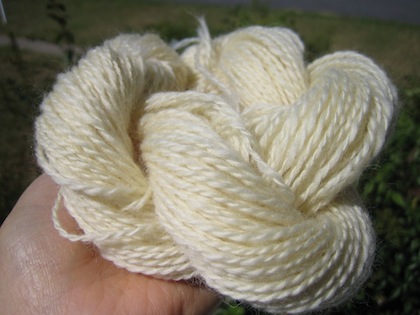
September 03, 2011
My First Cables, Redone But Still Not Like I Want Them
I have redone the cabled mitten, correcting the fabric gauge. Now it fits and feels flexible.
The pattern is Tera Johnson's Entwined fingerless mitts. I like my fingertips covered so I am knitting on beyond the pattern. I did some figuring, crossed cables behind to make them disappear, and brought the remaining cables to a logical conclusion.
However, now that I am looking at the result, I find myself annoyed that those two cables cross behind and not in front like the others. I believe I will go back one repeat, knit the cables as written, and let them blend directly into stockinette above. Will look blunt but will look better.
I am not versed in the way cables are supposed to look. Cables have always simply been there on sweaters, and all the cable motifs I've ever been around have been pretty ordinary and not elaborate or tapered the way Kate Gilbert's Wisteria or Margaret Mills' Maire Riding Jacket are.
I know my choice of handspun yarn is good. Five strands of singles plied together really do make cables stand out. I am almost out; I am going to have to spin more in order to make a second mitten. A terrible thing, eh, to need to spin more yarn?
Noticed that almost all my posts this week have been about mistakes I've made and things that haven't worked out. Sorry to keep pointing them out.
September 02, 2011
Yarn Judged on a Spindle
I find myself amused by a Coombs fair competition category: yarn on a spindle. I asked the local handspinning group and yes, the yarn is submitted for judging while on the spindle.
Would you have a competitive advantage if you used a really pretty spindle? What if the spindle had cutouts in the whorl and you used fibre that transitioned from one colour to another creating a pattern in the cutouts?
I don't see how a judge can assess yarn's consistency when the only part that's visible is the last few yards wrapped on the outside of the cop.
Would you have a competitive advantage if you used a really pretty spindle? What if the spindle had cutouts in the whorl and you used fibre that transitioned from one colour to another creating a pattern in the cutouts?
I don't see how a judge can assess yarn's consistency when the only part that's visible is the last few yards wrapped on the outside of the cop.
September 01, 2011
My (Much Too Tightly Knit) First Cables
I present to you my first knitted cables. Now if you'll excuse me, I need to pull them out. The cables are done properly; my knitting is much too tight.
August 31, 2011
Tog and Thel Together
Well, if the merino from yesterday was like handling tissue paper, this unseparated* Icelandic wool was like 30 lb bond.
It sits, untouched, because it came out differently than I intended and came out unsuitable to the purpose I'd picked for it. These things will happen. I spun it into strands that are too thin to have any loft or softness.
*Icelandic is dual-coated, so if the tog is not separated from the thel the results are hairy.
August 30, 2011
Combing and Salvaging Merino
Yesterday I told you Targhee wool has too little luster to suit my taste. You may be wondering why I'm showing you a box of combed merino wool today since it has even less.
I bought the wool a couple of years ago before coming to grips with my predilection, before realizing how much a glossy sheen is necessary to my happiness.
I also didn't know at the time how much I prefer to spin well-prepared, lofty fibre without noils or sections that resist drafting. When I bought this merino, the roving was the very opposite. The seller told me so and showed me a sample of the rustic yarn the roving would make. I said, oh, that's fine, and bought a pound because while I was informed my powers of discrimination were as yet unformed. My fault and a forgivable one.
Now I have combed the merino. I'd been meaning to do so for ages and it's good to have gotten that task off the "to do" list. I feel like I've salvaged the purchase.
Sixty-one grams, or just over two ounces remain. The matte texture remains. The waste might be good for stuffing. The combed wool is definitely going in the category of "wool with which to make gifts for family" not "wool for selfish knitting." The preparation is good, the wool is fine, and only the longest fibres are left. This combination would lend itself to an experiment in spinning extremely fine gauge yarn if I want.
The colour is a natural brown and the wool was probably raised in Alberta, both plusses in my book. Natural colour in general, I mean, not this particular shade of warm brown. I can see other people going crazy for it. Me, I like natural wool colours in the clear grey range.
August 29, 2011
A Cuff to Test Wool
I knit a cuff out of a little leftover Sweet Grass Targhee wool top I spun into yarn last year. The cuff was meant to show me how it wears and how I felt about wearing it.
This yarn was spun thicker than the fine fibre really calls for. You could dispute that and say I just want every yarn I spin to come out fine and you might be right. I untwisted a small piece and checked to see how comfortable I was drafting a thin strand. I found I could get quite a fine gauge, so that was good.
The wool has a lot going for it: softness, attractive colour, traceable to a region and to a breed, North American origin meaning less distance travelled, that sort of thing.
I found myself looking at the cuff and reproaching it for having a surface that was matte, not lustrous like the wool from longwool sheep is. The Targhee breed was derived from 3/4 finewool and 1/4 longwool sheep. No matter how much I want to believe it will, the matte surface is not going to suit my taste.
August 27, 2011
Sheep Spotting
Saw some local sheep while on Vancouver Island. I am looking up pictures of breeds, trying to identify these two. Strikes me this exercise is something akin to bird watching. Hampshire Down sheep, probably?
Back in Virginia, I amused myself by trying to identify breeds as assorted sheep milled around in a temporary corral and ring set up for a Mutton Bustin' event. I recognized the distinctive Roman nose of some sort of Leicester and a curly topknot that looked like Cotswold. Mutton Bustin' is part rodeo, part kiddie ride: a child in a vest and helmet holds on to the back of a sheep as long as possible. Have a look on YouTube for videos if you like.
August 26, 2011
Shibori Wet-felted Bag
Here is my first wet felting project, a felted bag. I was surprised how much I enjoyed scrubbing away at knitted fabric and making it change. This bag works as a cover for a stainless water bottle. It's just sturdy enough to stand up on its own. It has bobbles where I did some Shibori.
To start with, I knit a tube. Made the fabric more loose than I normally would because I read that as a rule you go up two needle sizes for knitted fabric you're going to felt.
I gave the fabric four unusual columns of stitches, creating the effect of squared-off corners. The phoney seam technique comes from Elizabeth Zimmerman's Knitting Without Tears, where she drops a stitch, then does the ladder back up again by successively pulling one strand through the open loop as for normal knitting, then two strands through the loop just formed. She uses it to create the appearance of a seam on a sweater knit seamlessly in the round. I know I've said so before, but it's good to take a technique in a book that you understand intellectually and actually try it out. With practice, I got faster at making the ladder run and doing up the stitches, and that was satisfying. I like the appearance of the column of stitches, the way it stands out.
I didn't know it at the time but there really wasn't any point dropping the stitches and making phoney seams. Wet-felting obliterated all traces of them.
Here is the Shibori I did, tying buttons under the fabric. I forgot to cover the surface with plastic wrap to keep the surfaces from felting. While felting, I had to rescue popped buttons and tie them back in.
The yarn that I made the felted bag out of was a skein I spun a couple of years ago. I used hand dyed wool roving from Scarlet Fleece, a piece of roving she tested colours on and not a particular colourway.
I gave the skein away, then got it back, and then it lingered around because there was such a small amount of yardage and I couldn't think of what to make. I even set the ball out at a guild meeting with a plea for suggestions but even though the ideas were well-considered, I felt fussy and disinclined to go with any of them. I made a few false starts with the handspun but nothing stuck until now.
August 25, 2011
Mothproofing Pervasive in Commercial Yarn
I am not surprised by this.
I like for information to be on the label.
Nowadays, most commercially spun knitting yarn contains a mothproofing ingredient.
–Margrit Lohrer, Morehouse Farm Merino Knits (New York: Potter Craft) p 33Makes me think of some vintage Mary Maxim wool yarn I saw in a Nanaimo, B.C. thrift shop. The label said it was treated for moths. I hardly ever look at commercial yarn but I was struck by the strangeness of a yarn label announcing the wool was treated with chemicals. Lohrer's point, I think, is that you need to be told what's on the yarn because mothproofing is unadvertised today. She goes on to say that her yarn is untreated. The unspoken conclusion is that she believes untreated wool makes for a better product.
I like for information to be on the label.
August 24, 2011
Roundup Weed Killer and Sheep Fodder
I had no idea.
In Australia when a forage crop is close to maturity, producers apply a dilute application of Roundup to "freeze" the crop to retain protein quality. They then turn the sheep in to graze. Once the crop is harvested, the animals are moved to a different pasture, and the crop grows back. Gary says the Roundup makes the plants "sick," but does not kill them.
–Tracie Roeder, "Where is Boddington, Western Australia?" Targhee Talk: The Newsletter of the U.S. Targhee Sheep Association, Vol 11 No. 3, July, 2011, p. 5
August 23, 2011
Rebecca Burgess' Fibershed Project
I am reading this blog, http://fibershed.wordpress.com. Rebecca Burgess has set herself the challenge of only wearing clothing sourced from 150 miles around her. That's fibre, dyes, milling or prep, fabric construction, tailoring, everything done close to home. She aims to promote and reestablish local custom milling in her area in order to restore jobs, give artisanal fibre growers a place for processing material, and divert local meat sheep wool from the waste stream. She demonstrates a high level of understanding of the local materials available to her through her use of natural, local dyestuffs and naturally-coloured fibres. Examples include brown alpaca fibre, fennel or oak gall dye baths, and coloured cotton varieties from Sally Fox, breeder of Foxfibre. By wearing unconventional clothing, Burgess opens a conversation about water pollution and occupational hazards from synthetic dyes, something she says she saw first-hand while travelling in Asia.
The results look stylish and her many collaborative projects make for vicarious thrills and aspirational reading. The public reaction she gets is really something, both in comments posted on the website and from passersby in real life. About a felted alpaca coat, the author posts on 2nd March, 2011, "it seems everyone dies for it when I'm walking down the street...there is some longing and pain involved when they realize it is not off the rack."
If you like to listen to podcasts and streaming audio while you spin yarn, Burgess has given some interviews: "Radical Ideas: Grow Your Own Farm-fresh Wardrobe," Crosscurrents from KALW News, June 8, 2011; "The Fibershed Project: Living One Year in Locally Grown Clothes," Sustainable World Radio, Oct 28, 2010*; and "The Fibershed Project," Cultural Energy, April 19, 2010.
*click on the little POD icon at the top left to stream audio if you don't wish to download the mp3 file.
ETA: the new Fibershed website is http://www.fibershed.com/. Burgess also has a lot of online content at http://ecologicalartist.wordpress.com/.
The results look stylish and her many collaborative projects make for vicarious thrills and aspirational reading. The public reaction she gets is really something, both in comments posted on the website and from passersby in real life. About a felted alpaca coat, the author posts on 2nd March, 2011, "it seems everyone dies for it when I'm walking down the street...there is some longing and pain involved when they realize it is not off the rack."
If you like to listen to podcasts and streaming audio while you spin yarn, Burgess has given some interviews: "Radical Ideas: Grow Your Own Farm-fresh Wardrobe," Crosscurrents from KALW News, June 8, 2011; "The Fibershed Project: Living One Year in Locally Grown Clothes," Sustainable World Radio, Oct 28, 2010*; and "The Fibershed Project," Cultural Energy, April 19, 2010.
*click on the little POD icon at the top left to stream audio if you don't wish to download the mp3 file.
ETA: the new Fibershed website is http://www.fibershed.com/. Burgess also has a lot of online content at http://ecologicalartist.wordpress.com/.
August 22, 2011
one hundred twenty-sixth and twenty-seventh skeins
Spun a couple of skeins of Gale's Art Blue Face Leicester in a blue that was not named and was not a repeatable shade of hers. One skein is 2 ounces and about 138 yards; the other is 1 1/3 ounces and about 112 yards.
Wasted 20 grams by combining three strands for a 3 ply and running out of one bobbin before the others. I expected that would happen because my fingers just couldn't seem to keep the gauge fine on the first spindleful, not as fine as I meant it to be.
I began by spinning wool on my laceweight spindle. I measured out the wool into three parts, spinning one and one-third ounces at a time. Once the spindle was full, I transferred the singles to a bobbin and continued until all four ounces of wool were spun. I plied using another spindle from The Spanish Peacock that I bought this year to use for plying after my old no-name spindle (the broken one held together with tape) finally had the biscuit. It weighs twice as much as the laceweight spindle and has a deeper hook to hold thicker yarn. Both are made of cherry and walnut.
August 20, 2011
Kitschy Vintage Plaques and Missing Wheel Pieces
Bought these two plaques at a thrift shop in Parksville, B.C. Jenny Jones, above is spinning flax from a distaff, and the Welsh Woman is spinning with a great wheel. There were some other plaques for sale as well, of ships or tavern scenes. The hook at the back showed they are made in England. A friend of the family tells me that these things were popular in B.C. for home decor in the 1920s. I find them amusing, with their rough patina, inexpensive metal, and coarsely realized images.
Strangely, the great wheel is depicted without a spindle or maidens nor a bat head as an alternative to maidens. I don't think this is a limitation of the medium, more likely a lack of understanding on the part of the artist regarding the way a great wheel should look. And to have the Welsh woman holding out a rolag on top of a wool handcard with one hand and putting her other hand on the wheel, that pose is completely staged.
Around the same time I found these plaques, I drove through Ladysmith, B.C. and saw a great wheel set outside an antique shop to serve as as advertisement. I was going down the highway at 70 km/h, so I can't be sure, but it looked as though the spindle and maidens were turned at an odd angle.
In an antique shop down the road in Chemainus, B.C. I saw most of a Canadian production wheel. I say most because while the bobbin and spindle were there, the flyer was missing. Imagine if you didn't know any better and thought you were getting a complete, functioning wheel.
August 19, 2011
Knaut-Rhuland House in Lunenburg, Nova Scotia
What do you do when you go to a designated world heritage site in a really old part of Canada? Go looking around town for evidence of handspinning.
I found it at the Knaut-Rhuland House museum in Lunenburg, Nova Scotia.
The textile room at the back holds a comprehensive collection of tools and supplies that museum interpreters must find well-suited to teaching the public about hand methods of fabric production. There is a great wheel with bat head, loom, inkle loom, warping board, spinning wheel, line flax, baskets of wool, basket of spindles and roving, swift, skein winder, hand cards for wool, handwoven fabric samples, a crude Turkish spindle made from twigs, and an enormous rustic forked distaff whose practicality I question. I was interested the line flax, of course, but sadly wasn't able to find out where the flax came from.
The Saxony spinning wheel had paint on the wood to highlight its turned details, a touch I've read is characteristic of wheels from French-speaking cultures in North America. There was a similar wheel in the front room.
Upstairs were the beginnings of socks on double pointed needles.
Also upstairs was a very old set of table linen labeled as a flax linen centre and serviettes. (Canadians say serviettes, Americans say napkins. I remember my Canadian-born grandmother once defended the word serviette, clinching her argument with the fact that napkins, nappies, go on babies' bottoms.) The set was made locally by hand at every stage from flax seed planted by a settler who came to the area in the mid-1700s. I won't post a photo of the linens because they are from a private collection on loan to the museum, but I will describe the workmanship. The material is fine, even, and smooth. Extensive embellishment was done in cutwork; that is, small holes were cut out in patterns and the edges bound with embroidery in the shape of leaves and flowers. Vines and blossoms are embroidered on the solid parts. I can't imagine anyone daring to wipe a greasy mouth with one of those serviettes.
In the narrow garden around the house were small sprouts, identified by the museum worker as flax, as well as dye plants at the back.
I found it at the Knaut-Rhuland House museum in Lunenburg, Nova Scotia.
The textile room at the back holds a comprehensive collection of tools and supplies that museum interpreters must find well-suited to teaching the public about hand methods of fabric production. There is a great wheel with bat head, loom, inkle loom, warping board, spinning wheel, line flax, baskets of wool, basket of spindles and roving, swift, skein winder, hand cards for wool, handwoven fabric samples, a crude Turkish spindle made from twigs, and an enormous rustic forked distaff whose practicality I question. I was interested the line flax, of course, but sadly wasn't able to find out where the flax came from.
| bat head on great wheel |
![]() |
| decorative paint on spinning wheel; line flax |
Also upstairs was a very old set of table linen labeled as a flax linen centre and serviettes. (Canadians say serviettes, Americans say napkins. I remember my Canadian-born grandmother once defended the word serviette, clinching her argument with the fact that napkins, nappies, go on babies' bottoms.) The set was made locally by hand at every stage from flax seed planted by a settler who came to the area in the mid-1700s. I won't post a photo of the linens because they are from a private collection on loan to the museum, but I will describe the workmanship. The material is fine, even, and smooth. Extensive embellishment was done in cutwork; that is, small holes were cut out in patterns and the edges bound with embroidery in the shape of leaves and flowers. Vines and blossoms are embroidered on the solid parts. I can't imagine anyone daring to wipe a greasy mouth with one of those serviettes.
In the narrow garden around the house were small sprouts, identified by the museum worker as flax, as well as dye plants at the back.
August 18, 2011
Acadian House Museum in Nova Scotia
Went to the Acadian House Museum in West Chezzetcook, Nova Scotia. The kitchen is restored to look as close as possible to traditional Acadian life in the area, which lasted hundreds of years and ended around 1970. The other rooms contain artifacts and exhibits that interpret Acadian society, religion, education, genealogy, and economic activities.
The economic activities stood out for me. Our guide stressed how many things the people put their hands to in order to make their livings and how marginal the profits were. She also said they were canny folks. The people around West Chezzetcook would buy goods one day's journey to the east from the people they knew there and then they would take the goods a day's journey west to the market in Halifax and sell the goods there for twice the price. The Halifax customers (who were English-speaking) didn't know any better, and it sounds like the French-speaking Acadians relished having the advantage. This makes sense in light of the British earlier having tried to expel the Acadians of the region. The West Chezzetcook Acadians escaped expulsion by hiding inland with the First Nations there. However, I think the Acadians at the Halifax market weren't the only ones getting the benefit of their horse trading and carting; the Halifax residents got convenience and that's worth quite a lot.
On a wall of the museum there is a newspaper clipping about an Acadian woman who knit traditional socks for the Halifax market and sold them up through the 1980s. There's a photo of her in the article, knitting away at her stall. The museum has some thick socks on display and some enormous sock blockers make of wire, with the thick wire bent into an outline of a sock.
There is a swift and on it is the coarsest yarn I've ever touched. No spinning wheel; the guide says the museum has artifacts that are donated by area families and I guess a wheel hasn't come along. Someone had made and donated a small, handwoven child's coat, though, to show how children used to dress.
We ate lunch at La Cuisine de Brigette on the museum grounds and the women who ran the cafe told us that handspinners came to an Acadian conference one year to do demonstrations.
August 17, 2011
Stack of 19th C and Early 20th C Books
One of the great things about a trip back to Canada is getting to scout the shelves of used bookstores and thrift shops. Here's a stack I selected.
Roughing It In the Bush, The Backwoods of Canada, and A Gentlewoman in Upper Canada are all either epistolary or autobiographical, each written in the early 1800s by a British immigrant woman about her life as a settler in the British colony that would become the province of Ontario. The Imperialist is a novel set in Ontario and written by a Canadian woman in the very early 1900s while an expat in Britain and India.
I read Roughing It In the Bush in university and I'd meant for a long time to get around to reading The Backwoods of Canada because I'd heard the authors, who were sisters, present dramatically different perspectives on much the same experience. Frankly, Moodie's writing is painful and I wanted to read Parr Traill to wash the taste out of my mouth. This second go-round, though, I feel more compassion for Moodie given all she had to put up with, and I find Parr Traill to be precious and unreal.
I have a hard time forgiving Parr Traill for evaluating the great wheel's value for settlers on the basis of how charming a young woman looks while walking back and forth spinning yarn. Moreover, I find her meeting with the good wife who spins and outfits her family in homespun to be rather flat and static, like a catalogue description. Compare that to Moodie's stories of the rascally, independent old handspinner neighbour who tries to cheat a young man by selling him re-footed socks.
The quaint title of A Gentlewoman in Upper Canada made me want to buy it, along with its self-portrait of the author looking someone on the front of a Jane Austen or Georgette Heyer novel. I like Langton. I can't decide whether she comes off well as a person compared to Moodie and Parr Traill–Langton strikes me as having been much better adjusted to the life of a settler–or whether I prefer Langton to them because she is a much less self-conscious writer. Her letters and journals are directed solely to family members back in England and she never revised their pages for publication. What I am trying to say is, she hasn't got an axe to grind. She get on with things. She writes:
One of the novelties John saw on his late trip was a lady knitting a pair of stockings in one, that is, doing double knitting from top to toe, and after taking off the latter, having the one stocking completed within the other. This will be more interesting to Cicely than to you. The lady thought it saved time, I cannot understand how it should do so. I do not, however, comprehend the performance exactly; perhaps I may be able to obtain some further information through John.She relates the information because she thinks this Cicely will find it interesting and possibly helpful, not because it will serve to dissuade would-be settlers from emigrating (Moodie) or prepare them (Parr Traill). Langton finishes up by describing her current knitting project for her brother, a "pair of mitts for driving in, having a forefinger as well as thumb distinct, with space, however, for it to join its three companions, when not requiring its own separate home." (Anyone driving in 1838 would be driving a team of horses. Although I've gone by sleigh I can't remember how a driver holds the reins, but the shape of the mitts must make practical sense somehow.)
Duncan's The Imperialist is absolutely brilliant. The author takes ordinary things and turns them into subtle commentaries on character, often as complete zingers. This excerpt about a bachelor's housekeeper (where the omniscient narrator illuminates the bachelor's point of view) is better when read in context but I think you will get the gist: "Mrs. Forsyth was an excellent hand at pressed tongue [food] and a wonder at knitted counterpanes, but she had not acquired tact and never would." Another character's industrious nature and perpetual state of indignation is established early in the book when the hired girl takes the May 24 holiday off without permission:
"I believe I know the reason she'll say," said Advena. "She objects to rag carpet in her bedroom. She told me so."I like how ridiculously unaware the mother is that she's advancing a specious argument. Having a rag carpet in your spare room is not exactly the same as using a rag carpet yourself and it doesn't give you the moral authority to insist your employee like the rug as a hand-me-down. Power relationships underlie the entire book, between people, town and country, Empire and Canada. The narrator lets the reader in on all of it while the characters move between obliviousness, recognition, and epiphany. It's done with a wonderfully light touch.
"Rag carpet–upon my word!" Mrs. Murchison dropped her knife to exclaim. "It's what her betters have to do with! I've known the day when that very piece of rag carpet–sixty balls there were in it, and every one I sewed with my own fingers–was the best I had for my spare room, with a bit of ingrain in the middle. Dear me!" she went on with a smile that lightened the whole situation, "how proud I was of that performance! She didn't tell me she objected to rag carpet!"
"No, Mother," Advena agreed, "she knew better."
I read these books hoping to find clues about how handspinners used to fit into Canada's history and how they might again, and I found some. You can't get away from imported cloth and Manchester gets mentioned quite a few times as the source of industrial production. The settlers depended on their relatives in England purchasing and shipping goods to them. Still there is some hand knitting locally, for personal use or for pay, and quite a lot of clothing and household textiles constructed on the spot. The Imperialist is very good for getting an idea of how farmers' markets operated a hundred years ago, something that relates to the post I will do next.
August 16, 2011
August 15, 2011
one hundred twenty-fifth skein
My one hundred twenty-fifth skein is more superwash BFL spun to match the last couple I made out of this fibre. Looks nice and glossy. Right after I took the photo, I wound the skein up into a ball so I could get the mittens finished.
I may have mentioned that for a while now this gauge, this size has been more or less what I've spun. My next skein will be spun the same size for singles but I will ply three strands together, not two. I want some variety and I want the drape that 3 ply is supposed to give to knitted fabric.
August 13, 2011
Old Songbook with Turn, Turn, My Busy Wheel
I bought an old songbook published in 1940 for use in Canadian schools, A Song Book compiled by Ethel A. Kinley, because I liked the looks of it and wanted to learn some old-fashioned songs.
The book contains English words set to the music for Gluck's Dein Leben Sei Begluckt (Turn, Turn, My Busy Wheel). I tried picking out the melody on a piano but found the words more interesting. The spinner sits by firelight as she spins yarn, dreaming of her past when she was crowned Queen of May and wondering about her future. "Will the frail thread of life I twine run as smoothly as thine?" she asks her wheel.
August 12, 2011
August 11, 2011
Sheep Beads
I bought these cute sheep pendants from Sandra, a glass bead maker and handspinner. I got to choose from the many in her box of lampwork beads when I met her near Parksville, B.C.
It took me a while to pick the ones I liked best. The beads are all a little different. There are various colours, including colours never found on sheep in nature. Each sheep has a unique expression that comes from the placement of the head, ears, and so on. Some are round rather than flat in shape.
Sandra also had orifice hooks with sheep bead handles.
It was fun to listen to other handspinners pick over the beads and make jokes like, "This sheep is such-and-such a breed because its ears go up." What was it, Cheviot?
As always, I need to disclose anything that might influence my opinion of an item: Sandra gave me a price break on the white sheep when she heard I was taking it back to my guild at home to put into our holiday gift swap in December.
Sandra can be contacted through her blog, sueze.wordpress.com; expect a bit of delay in reply.
August 10, 2011
Daring the Yarn to Run Out
The yarn stretched longer than I thought, reaching almost to where the pinky finger tip goes in the mitten. Have dug out the remainder of the wool and started to spin more yarn.
August 09, 2011
Knitted Increases and Angles
Have finished the first white mitten and gotten part of the way through its mate.
This photo shows quite clearly the lines of increase stitches along either side of the thumb's base. I think increase stitches work very cleverly to make the fabric go off at an angle. Reminds me a little of those faces of forming crystals we had to learn about in introductory geology. Something about a particular angle depending on the molecules and the structure, I think. In this case the angle depends on how many increase stitches you insert over however many rows.
This is the fourth pair of mittens I've made and they've all had increases placed like this. With the next pair I should try forming the thumb a different way, one where it doesn't angle out to one side, so I can broaden my experience.
I expect I'm going to run out of yarn before I get much above the mitten's knuckles. Need to spin some more.
August 08, 2011
one hundred-twenty-first through -twenty-fourth skeins
Yarn spun from some dyed bits of wool roving marked "local" at the Loom, a supply shop near Duncan, B.C. Must be from a down breed because the wool has a lot of springiness. Squish it and it bounces back.
I find this wool more interesting after it's spun. Spinning down breed wool is more of a chore than with other types of wool. I have to tug at the roving in spots as I go because it won't draft smoothly, and I have to accept slubs.
The colour is what induced me to buy it. The bin of wool also contained strips of roving in muddy dark colours. It was fun to hunt for the bits of intense, clear colour that I liked.
One of the spinners I talked to when I visited Halifax, N.S. said that when she first started spinning she spun with down breed wool raised locally. She switched to more conventional breed wool for handspinners afterward but she got the warmest, most durable socks out of that yarn.
August 06, 2011
Mitten with Just the Thumb Left to Finish
The first white mitten is almost finished. Just the thumb to go.
The intended recipient likes to garden. The puckish part of me wants to knit the thumb using green yarn.
August 05, 2011
Handspun in Newfoundland
Meet Bill. Bill is from Newfoundland. Up through his late teens, Bill wore handspun, homemade clothes exclusively. His grandfather kept sheep and made Bill's mother a great wheel so she could spin yarn, and that's where the family's clothes came from. He thinks he remembers the sheep breed was called Shetland.
Bill says other people he knew in Newfoundland at the time wore handspun too. They did it out of necessity. People kept their spinning wheels until the late 1960s when Americans came and paid five to ten dollars a wheel.
Bill is wearing a handsome fisherman's sweater he knit himself with commercial yarn. It has honeycomb cables in the middle, seed stitch at the sides, and what he calls "some sort of cable" in between. He enjoyed doing the math to change the pattern from a crew neck to a shawl collar, which he likes better.
Bill learned how to spin yarn with his mother's great wheel when he was young. Mine was the first drop spindle he'd seen. I showed him how my drop spindle works and he could see the similarity between its action and a great wheel's.
Newfoundland and Labrador's tourism site is here. If you need some orientation, the province is Canada's easternmost. I'm from the westernmost province.
I wonder what they thought, when they sold their spinning wheels. Maybe they told themselves they didn't need spinning wheels anymore and it would be good to have the money. Maybe they figured they could always build another.
August 04, 2011
Quebec and Spinning Wheels
Quebec was once so closely identified with spinning wheels that the province put one on the front of this vintage tourist map.
Photo taken with permission at John W. Doull, Bookseller in Halifax, NS.
August 03, 2011
"Can I Play With You Guys?"
Remember when you were young and you approached a bunch of kids you didn't know and asked if you could play?
I did that, more or less, with a World Wide Knit in Public Day event in Halifax. A group that meets regularly got use of a public library lawn and posted the details on Ravelry which is where I, the tourist, found out about them. They were great. I found a place at the edge of the group and spun on my spindle and said hello. Everyone was knitting. They talked to me about yarn they spin, fibre they dye, and fibre that's locally available.
August 02, 2011
one hundred-nineteenth and -twentieth skeins
Nothing special. Two ounces of BFL superwash spun up into yarn. Spindle-spun, as usual. Destined to be mittens like yesterday's grass-green ones, except white unless I recklessly throw them into a pot of hot KoolAid and make them some other colour.
August 01, 2011
Grass-green Mittens
June 28, 2011
Gone Fishing
Need to put the "gone fishing" sign out. Back when I can. I do have handspun-related stuff to write about but no time to do so right now.
June 27, 2011
"We'd Be Sheep"
I heard a droll saying the other day about the dangers of gullibility: "if that were true"-that is, if we were that gullible-"they could knit us, for we'd be sheep."
I laughed and laughed.
June 25, 2011
June 24, 2011
Take two spindles and call me in the morning
I met a woman who told me she spins yarn with supported spindle and Saxony wheel as a form of pain management, because the mind can only focus on so much at a time and handspinning helps.
June 23, 2011
Reminiscences
We sat around the dinner table
And they told their stories
Of a strong woman
Whose mother-love
Had covered her children
With handknit sweaters
And mittens with strings
And care
And sent them out in the world.
And they told their stories
Of a strong woman
Whose mother-love
Had covered her children
With handknit sweaters
And mittens with strings
And care
And sent them out in the world.
June 22, 2011
"A Scarf's a Scarf"
Here's a quote from Rob Hopkins, founder of the Transition movement, regarding the absurdity of importing and exporting things that might as well be consumed domestically: "We [U.K.] send 43 000 scarves to Canada every year and we import 49 000 scarves from Canada. I think a scarf's a scarf, isn't it really. Frankly. I've never seen someone say, 'Oh, it's Canadian.'"
It's funny he makes the potshot, actually, because he goes on to talk positively about things that are representative of a region. As a loyal Canadian I think a well-made Canadian scarf could be representative of its place of origin and be worth owning on that basis. I do take his point though and understand he makes it in the context of trying to reduce redundant world-wide shipping to decrease fossil fuel use and foster local production and consumption.
Here's the whole speech, "Recipes for Resilience at Dartington" which contains props and stories about initiatives like the Trash Catcher's Carnival, public nut trees, and the Gasketeers. Runs 39 minutes. Good if you like to spin or knit while listening to audio.
http://www.youtube.com/watch?v=6XSykiCewdc
It's funny he makes the potshot, actually, because he goes on to talk positively about things that are representative of a region. As a loyal Canadian I think a well-made Canadian scarf could be representative of its place of origin and be worth owning on that basis. I do take his point though and understand he makes it in the context of trying to reduce redundant world-wide shipping to decrease fossil fuel use and foster local production and consumption.
Here's the whole speech, "Recipes for Resilience at Dartington" which contains props and stories about initiatives like the Trash Catcher's Carnival, public nut trees, and the Gasketeers. Runs 39 minutes. Good if you like to spin or knit while listening to audio.
http://www.youtube.com/watch?v=6XSykiCewdc
June 21, 2011
Supplement that Quarter Pound of Fibre
I wrote the other day about handspun integrity, how handspinners as a whole do not limit themselves to working only with handspun but use commerical yarn as well, either on its own or in combination. I myself keep pretty strictly to handspun. I didn't mention the fact in that post. I don't like drawing attention to areas where I fall in a lonely place on the Venn diagram of handspinners and I didn't want anyone to get the idea I judge anyone who uses commercial yarn because I don't. I can't relate but I know one man's fish is another man's poisson. They always seem happy so I am happy for them.
These multi-coloured braids I have, I don't want to stretch the fibre by combining it with commercial yarn. This is mainly because getting to spin is the whole attraction for me. Buying yarn means missing an opportunity to spin yarn. The other consideration is my desire for the whole project to look coherent and undiluted. I think, given my inexperience and middling skill in creating wearable fabric, my chances of achieving clarity go up if I use only one type and one colourway of fibre.
Let's have a photo of the braids in question.
Gale's Art BFL in Velvet Elvis (4 braids) and a turquoise semi-solid |
There they are and there's a plain semi-solid as well. They're all from the same dye artist, Gale's Art. The multi-coloured braids are named Velvet Elvis and the semi-solid is called turquoise. I bought the Velvet Elvis first. Later I bought a semi-solids colour card from Gale and I realized that some of the colours that go into the Velvet Elvis are available as semi-solids. Oh, I felt clever and pleased with myself. That's why I was prepared at Maryland Sheep and Wool to buy turquoise at Gale's booth. I bypassed another semi-solid called ashes that would have matched Velvet Elvis as well. The turquoise is much more me. Not only do the semi-solids partner well, they're priced lower.
Having these related braids makes me feel like I have some versatility. I can make a separate items and wear them together looking impressively coordinated. Or, I can make them all into one item. You've probably seen a sweater with a different colour at the ribbed collar and cuffs. There's the possibilities of stripes in the body or Fair Isle patterns. Intarsia might look dated. Woven chequer fabric is possible too, though difficult to match at seams in a garment.
From prior experiments, like the chair pad I made, I expect that spinning singles from these multi-coloured and semi-solid braids and combining the colours in the plying stage would fleck the fabric erratically. Not the best look. Holding the braids together to spin a single would take more concentration and skill in blending than I'm willing to dedicate. Besides, what is the point of that last option? Velvet Elvis already contains turquoise and blending in a little bit more won't give much return for the effort.
There is another way you could stretch the braids: run them through a drum carder with more fibre, the fifteen ounces of humbug BFL I have for example. (Velvet Elvis is dyed over a 75/25 mix of light and naturally dark fibre, sometimes called swirl or humbug. I bought my humbug for $24/pound; it has gone up since then but is still about half the price of an equivalent weight of dyed braids.) I saw on Ravelry pictures of someone's before and after shots where she took a few multi-coloured braids in related colourways and made batts. The result was pleasant. The fibre lost the distinct colours and gained a soft heathered look. Brilliant solution if you've shopped impulsively and wound up with an assortment of braids that would produce one-skein wonders otherwise.
I don't plan to make heathered batts. The guild's drum carder is out for refurbishment. I have little experience using a carder and while I'm sure a drum carder favours the brave I think it also favours those that have the touch. I feel inauthentic when I wear heathered colours in commercial fabric. Clarity and intensity are what I like. A batt gives a fuzzier yarn and I like a smoother yarn that shows the gloss of Blue Face wool better. I like to know what I'm getting into and who knows what would come out of the drum carder: snarled neppy bits, irregularly blended colour, chaos.
June 20, 2011
Augment that Quarter Pound of Fibre
Assuming you're not making a project from scraps and oddments, it is generally true that a large handspun project requires you to buy a large amount of the same fibre. The supply issue can be as much of a deterrent as the project management involved in spinning skein after uniform skein.
Let's take a food analogy. You buy a delicious loaf of organic, crusty bread with lots of seeds on top to make lunch for a few friends. Say you spend five dollars for the loaf and some extra for a jar of almond butter and a jar of blackberry blossom honey to spread on the slices. Lunch goes well. You get ideas about catering lunch for your guild or filling your freezer and pantry with a year's supply for yourself. Now, what was a reasonable price to spend on a small lunch starts to look prohibitive when you calculate the cost for lots of lunches. It's much the same situation with spinning fibre.
A lovely, dyed four ounce braid for $15+ is a manageable cost. That amount of fibre is small-time. Multiply that by six or eight times the amount and you'll want to start looking at undyed roving by the pound or whole raw fleece which costs less by weight. A pound or a fleece costs more at one go and because of this it appears cheaper to buy a braid here and there. Much more colourful, too. Supply shops' packaging makes a quarter pound amount the easy default option to select, just like bakeries sell one loaf in a bag, not a dozen. Therefore, I have turned my mind to consider ways in which these braids can be made to amount to larger quantities.
There's the obvious: buy more of them. I have four of the same multi-coloured dyed braids that I ordered by mail last year on a day I was in a buying mood. I haven't touched them. They intimidate me with sheer numbers. You know how you put off using the good stuff? Four is the highest number of braids of any one colourway I've ever bought and a pound is the most I've ever bought of one type of fibre in one colour. I originally thought I'd make some small items with these braids for other people. Then I thought I'd make one large item for myself, but held off because based on what experienced knitters and spinners told me I doubted the amount would stretch far enough. I can get more; the dye artist is able to replicate the colourway. Maybe I should if it means being able to get on with the project.
New braids would be a different dye-lot but there is not such a difficulty avoiding demarcation with unspun fibre as there is with balls of commercial yarn. You spin a little from one braid and a little from another and thereby blend the whole.
As an alternative to buying more of the same, there is the meatloaf trick where you extend the premium fibre with cheaper ingredients. There are three types of fibre to add, commercial yarn, solid-colour braids, and undyed fibre, and there are a few ways to incorporate them. This post is getting lengthly so I will write about supplementing fibre tomorrow. It's interesting. It gives the opportunity to use more brains than money, and I trust it takes just as much good taste as it does to simply buy more of the exact same pretty fibre.
Let's take a food analogy. You buy a delicious loaf of organic, crusty bread with lots of seeds on top to make lunch for a few friends. Say you spend five dollars for the loaf and some extra for a jar of almond butter and a jar of blackberry blossom honey to spread on the slices. Lunch goes well. You get ideas about catering lunch for your guild or filling your freezer and pantry with a year's supply for yourself. Now, what was a reasonable price to spend on a small lunch starts to look prohibitive when you calculate the cost for lots of lunches. It's much the same situation with spinning fibre.
A lovely, dyed four ounce braid for $15+ is a manageable cost. That amount of fibre is small-time. Multiply that by six or eight times the amount and you'll want to start looking at undyed roving by the pound or whole raw fleece which costs less by weight. A pound or a fleece costs more at one go and because of this it appears cheaper to buy a braid here and there. Much more colourful, too. Supply shops' packaging makes a quarter pound amount the easy default option to select, just like bakeries sell one loaf in a bag, not a dozen. Therefore, I have turned my mind to consider ways in which these braids can be made to amount to larger quantities.
There's the obvious: buy more of them. I have four of the same multi-coloured dyed braids that I ordered by mail last year on a day I was in a buying mood. I haven't touched them. They intimidate me with sheer numbers. You know how you put off using the good stuff? Four is the highest number of braids of any one colourway I've ever bought and a pound is the most I've ever bought of one type of fibre in one colour. I originally thought I'd make some small items with these braids for other people. Then I thought I'd make one large item for myself, but held off because based on what experienced knitters and spinners told me I doubted the amount would stretch far enough. I can get more; the dye artist is able to replicate the colourway. Maybe I should if it means being able to get on with the project.
New braids would be a different dye-lot but there is not such a difficulty avoiding demarcation with unspun fibre as there is with balls of commercial yarn. You spin a little from one braid and a little from another and thereby blend the whole.
As an alternative to buying more of the same, there is the meatloaf trick where you extend the premium fibre with cheaper ingredients. There are three types of fibre to add, commercial yarn, solid-colour braids, and undyed fibre, and there are a few ways to incorporate them. This post is getting lengthly so I will write about supplementing fibre tomorrow. It's interesting. It gives the opportunity to use more brains than money, and I trust it takes just as much good taste as it does to simply buy more of the exact same pretty fibre.
June 18, 2011
Beginning of an Onion/Indigo Dyed Mitten
You could say I'm not one to let grass-green yarn grow under my feet.
Wish I'd spun the yarn a touch fatter since the fit of the mitten cuff is a little tight on me. Fortunately, this mitten doesn't need to fit me and most women have smaller hands than I do. The other day I tried on a friend's Chrysanthemum mitten and found it snug. Colourwork doesn't stretch like stockinette. I am either going to have to guess where to end the tip of this mitten or borrow someone's hand to check the fit.
I am apprehensive over whether there's enough yardage for complete mittens in the two wee skeins. I've done fingerless mitts before but not full mittens.
Happy World Wide Knit in Public Day! Find a KIP event near you with wwkipday.com.
June 17, 2011
one hundred-eighteenth skein
This skein is a match for the previous one, and comes in a few yards shorter. Tried to keep the singles to 36 wpi so the yarn wouldn't be too thin.
June 16, 2011
Historic Integrity
Someone told me the other day about a living history museum she worked at before moving here. The museum had an interpretive program and collection that remained the same for quite a long time. Then the museum changed them. I gather these were sweeping changes. She said the staff was told the museum would only present to the public objects and information they could prove were accurate for that place for those that lived there during the historical time period.
Textile pieces that did not meet the new criteria were taken off display. These were pieces that had been part of the exhibits for a long time and that were missed by the public once they were removed. Given the time period, I expect these textiles were made of handspun if original.
I'm sure that rigorous application of historical research is commendable. At the same time, it makes me sad to think that textiles should have no place when they were once considered museum quality. Sad that concern for conformity and authenticity should crowd out the long-established and the familiar. That inherent value due to workmanship, age, or rarity should be eclipsed by the textile's contextual value, the fact that they don't belong because the rules have changed.
I suppose a museum can't exhibit everything but personally I would find interesting an exhibit that displayed misfit textile artifacts with explanations.
June 15, 2011
Handspun Integrity
I saw a sign at a bakery that urged people, those concerned about the organic integrity of the loaves they buy, to slice their bread at home because the bakery slices both organic and conventional bread using the same machine.
I thought that was a bit much.
I asked the baker and he said yes, there are customers who have expressed concern to him about the integrity of the bread.
You, you who have read this far and who understands this blog is about handpun yarn, know that somehow I am going to bring the conversation around to the inedible sort of fibre.
Let me describe handspinners to you. The ones I know are eclectic. They'll make items from only handspun and they'll make items from commercially-spun yarn. They'll undo sweaters, dye the yarn, and knit new things. They'll spin a strand of yarn by hand and ply it with commercial thread or yarn rather than more handspun. They are very knowledgeable about the fibre they spin and the yarn they buy, and they keep different types compartmentalized and separate for their projects unless blending to achieve a particular purpose; however, there is not the same attitude of, shall we say, alarm over the prospect of commingling as there seems to be regarding rogue crumbs at that bakery.
There's at least one sweater pattern, King of Confidence on Knitty, that cleverly uses commercial yarn for the body of the sweater and handspun yarn for the circular yoke. The colourful thick and thin handspun creates a decorative accent near the face.
I thought that was a bit much.
I asked the baker and he said yes, there are customers who have expressed concern to him about the integrity of the bread.
You, you who have read this far and who understands this blog is about handpun yarn, know that somehow I am going to bring the conversation around to the inedible sort of fibre.
Let me describe handspinners to you. The ones I know are eclectic. They'll make items from only handspun and they'll make items from commercially-spun yarn. They'll undo sweaters, dye the yarn, and knit new things. They'll spin a strand of yarn by hand and ply it with commercial thread or yarn rather than more handspun. They are very knowledgeable about the fibre they spin and the yarn they buy, and they keep different types compartmentalized and separate for their projects unless blending to achieve a particular purpose; however, there is not the same attitude of, shall we say, alarm over the prospect of commingling as there seems to be regarding rogue crumbs at that bakery.
There's at least one sweater pattern, King of Confidence on Knitty, that cleverly uses commercial yarn for the body of the sweater and handspun yarn for the circular yoke. The colourful thick and thin handspun creates a decorative accent near the face.
June 14, 2011
one hundred-seventeenth skein
An ounce of superwash BFL wool dyed with onion skins and mordanted with tin, overdyed with indigo, spun into about 104 yards.
The original blotchy look evened out with spinning into a more overall olive colour.
I have another ounce left. I could spin it the same way, the roving torn lengthwise into thin strips, or I could predraft the fibre (attenuate the thick roving into a thinner roving) which when spun would produce long stretches of distinct colour. I hope to knit the yarn into mittens. The mittens will be fraternal anyway but spinning the second half differently would produce a more noticeable fraternal effect. I think I'm talking myself out of that option. Maybe another time.
June 13, 2011
Another Saturday, Another Market
I was at an outdoor market on Saturday, hanging out with friends, and I took along my drop spindle to occupy my hands and (hopefully) attract shoppers to my friends' booth. We were on pavement so I picked this colour of BFL to spin: it was easily visible against the dark surface. Though picked is probably overstating the case. What I actually did was open up a bucket of fibre and grab the first thing off the top that was pre-measured and ready to go out the door with me.
I like to weigh out an amount to spin, rather than spinning until there's too much crammed on the spindle for it to turn. Sort of like putting potato chips into a bowl rather than eating out of the bag. I can see how much I've gone through.
I also like to tear strips off the side of multi-coloured roving, strips about the width of a pencil, and spin them one after the other. That way you go from one colour to the next rapidly and there's less chance of colour pooling in one area later in the fabric. This fibre was already torn into strips which was good because the procedure is best done indoors over a clean floor that won't add bits to the fibre as you move it around.
This piece of roving was kettle-dyed, not handpainted so the colour is very blotchy. I don't know if spinning it in strips will make all that much difference the way it would to something done on a gradient or done with multiple, distinct colours. Still, I find drafting from a thin strip is easier for me to do. With the whole piece of roving, I somehow always manage to draft from only one side of the full width and leave the rest of the working end untouched. Makes me feel inept. Thin strips make me feel capable. They also make me feel quick because I get to the end of one so much faster than I get through whole roving.
Back to the market. The weather was hot enough to be uncomfortable, so I didn't spin all that much. There were only a few people who were curious. One woman said she had never seen anything like it. I could tell she was pleased to run across something so novel. I sensed someone looking over my shoulder and found a tall, dark young man in an Ecuador soccer jersey trying to see how the drop spindle worked. I got out the spare and let him try, talking him through it.
June 11, 2011
one hundred-sixteenth skein
The ounce of humbug BFL, spun to make about 108 yards. Irregular because I spun this in public while talking, picking it up and putting it down, and generally being careless. That's the way it goes sometimes and that's okay.
June 10, 2011
Handspinners and Hot Weather
After reading my last post you might be wondering why I'm thinking about wearing woolly things in hot weather. I spin yarn and almost all of my handspun to date has been made out of wool and I expect that will continue until I find some really nice flax to spin and I get up my courage to spin flax. I like to talk to unsuspecting people about handspun to try and get them to consider spinning yarn themselves because handspun is a pleasure to make and gets you beautiful fabric. When I chat up handspun's fine points it's nice to have some handspun on me. The handspun items I have been able to make so far have been accessories for winter wear and it would look more than a little demented to pull a fuzzy mitten out of my pocket in mid-summer to show it around.
I think other handspinners and knitters have the same sort of seasonal dilemma. (Based on all the finished objects at guild show and tell displays, I think the majority of handspinners today spin yarn to knit, whereas several decades ago they were more likely to weave what they spun. Very few handspinners spin flax, probably because flax is not as easy to manage as wool and because linen yarn is better for weaving than it is for knitting.) They may not necessarily be out to promote handspun as much as I am but they want to wear what they've made. I hear that the wool festival in October known as Rhinebeck has an advantage over Maryland Sheep and Wool in May in terms of being an opportunity to wear handknits and to watch a parade of handknits go by.
To try to design a handspun wool item for wear in warmer weather, I would spin as thin as possible to create a fabric that would trap the least heat. I would spin as semi-worsted as possible for the same reason, rather than semi-woolen. I would weave rather than knit to make the fabric as flat and thin as possible. I would make an item that would be worn loosely around the body, such as a loose jacket or a skirt, or an item to be carried, such as a satchel. Still, I don't think I could come up with anything for hot weather.
I have heard that alpaca and qiviut create fabrics that keep you warmer than sheeps' wool does. I wonder if there is any difference between wools from different sheep breeds and what the general principles would be. I expect that longwool types would give you the flattest, least lofty fabric.
I think other handspinners and knitters have the same sort of seasonal dilemma. (Based on all the finished objects at guild show and tell displays, I think the majority of handspinners today spin yarn to knit, whereas several decades ago they were more likely to weave what they spun. Very few handspinners spin flax, probably because flax is not as easy to manage as wool and because linen yarn is better for weaving than it is for knitting.) They may not necessarily be out to promote handspun as much as I am but they want to wear what they've made. I hear that the wool festival in October known as Rhinebeck has an advantage over Maryland Sheep and Wool in May in terms of being an opportunity to wear handknits and to watch a parade of handknits go by.
To try to design a handspun wool item for wear in warmer weather, I would spin as thin as possible to create a fabric that would trap the least heat. I would spin as semi-worsted as possible for the same reason, rather than semi-woolen. I would weave rather than knit to make the fabric as flat and thin as possible. I would make an item that would be worn loosely around the body, such as a loose jacket or a skirt, or an item to be carried, such as a satchel. Still, I don't think I could come up with anything for hot weather.
I have heard that alpaca and qiviut create fabrics that keep you warmer than sheeps' wool does. I wonder if there is any difference between wools from different sheep breeds and what the general principles would be. I expect that longwool types would give you the flattest, least lofty fabric.
June 09, 2011
More About Hot Weather and Wool
At an event this past weekend, I asked some men wearing kilts about the fibre content of their kilts and about their experiences of wearing wool in hot weather.
One man said that his kilt was acrylic. Another said his was wool, and he'd chosen to wear a kilt made from 10 ounce weight fabric as most suitable for the hot weather, and moreover, except for around the waist where the fabric is close to the body, the design of the kilt makes it comfortable in hot weather.
They had some tartan fabric on display and I got to feel the difference between 10 ounce fabric and a heavier weight which I believe from looking at the shop they recommended, Scottish Lion, could be as heavy as 16 ounces.
Another man, when he heard me asking about wool in hot weather, said that when he was young he wore a baseball uniform made out of wool. The team was told that wool would cause an evaporating effect with their perspiration and keep them cool, but he doesn't think it ever worked.
One man said that his kilt was acrylic. Another said his was wool, and he'd chosen to wear a kilt made from 10 ounce weight fabric as most suitable for the hot weather, and moreover, except for around the waist where the fabric is close to the body, the design of the kilt makes it comfortable in hot weather.
They had some tartan fabric on display and I got to feel the difference between 10 ounce fabric and a heavier weight which I believe from looking at the shop they recommended, Scottish Lion, could be as heavy as 16 ounces.
Another man, when he heard me asking about wool in hot weather, said that when he was young he wore a baseball uniform made out of wool. The team was told that wool would cause an evaporating effect with their perspiration and keep them cool, but he doesn't think it ever worked.
June 08, 2011
Longevity of Wool Items
Someone told me they'd been shopping for rugs and been told, "Here is a rug that will last you a hundred years, here is another rug but it has inferior fibre and silk in it so it will only last fifty years."
Only fifty years. Wow. I wonder how long my handspun items could last. I suppose it's a combination of the type of fibre you spin, the method of constructing the fabric, and the wear it has to withstand. I hear handspun socks can last a distressingly short amount of time or conversely a longer time if knit tightly and reinforced.
June 07, 2011
Drop Spindles are Fascinating
Forgot to say, when I was out spinning in public with my drop spindle, some people stood and watched the motion of the spindle with fascination. Normal for that to happen.
June 06, 2011
Lots of Foot Traffic at our SIP
Went through most of the ounce of the humbug wool while spinning in public (SIP) at the farmers' market Saturday.
We got a lot of foot traffic and inquiries at our guild booth. Wish I'd brought more fibre festival brochures to give out.
We had four spinning wheels and my drop spindle going. Our display table was covered in a wonderfully fuzzy hodgepodge of assorted fibres, skeins, mitts and other small handspun accessories, and a beaded Citron shawl.
Spinning yarn outside with friends is pretty good. There was music from an acoustic band. We had grass underfoot and trees ringing the area around us.
When you take yarn spinning outside, you have to talk about the weather. The temperature started out okay, fortunately, although it rose to 26 C / 80 F by midday when the market closed. We had a canopy over us shielding us from the sun which made a great deal of difference to our comfort. With SIPs in Virginia, there's a slim window of weather where we're able to spin, where our fingers aren't either too chilly or too sticky from humidity and heat to draft fibre.
Enough talking about the weather. You are waiting for me to tell you stories about the people we met. They asked the usual questions. As you might expect at a farmers' market, folks were interested in fibre as a useful product of nature. Some of them showed ambition beyond what we have ourselves. We were asked, "I've planted cotton on my property and wish to learn how to spin it, can you advise me?" and "I plan to get a small flock of sheep for meat and wool, what breed do you recommend?" I could joke that one reason our little group of volunteers has time to demonstrate handspinning in public is because we are not spinning fine cotton yarns and managing flocks of fibre animals. Probably a truer reason is because we like a good SIP. You make time for what you like to do. Other members of our guild do spin cotton and raise sheep–or alpacas, cashmere goats, and angora rabbits.
A man at the farmers' market told me there was an alpaca farm near his place and then one day the alpacas and the owners were gone and a foreclosure notice went up.
There was a woman who came and talked to us, a knitter whose voice had a trace of an English accent. She said that in England everyone used to knit but they didn't teach it in schools, and you would knit because a sweater was too expensive to buy. I've never known a world where a sweater was too expensive to buy. Certain sweaters, yes. Sweaters as a category, no.
June 04, 2011
Dip into the Fibre Stash and Pick...What?
It's sort of like having nothing to wear. I am considering criteria and possibilities as I chose which fibre I will take with me today to spin in public on a drop spindle.
The fibre needs to be visually interesting, eye-catching, and that probably means dyed. So that eliminates undyed fibre except perhaps that intense naturally dark BFL I have.
The resulting yarn needs to be good yarn despite containing inconsistencies that creep in while half my attention is given to talking to people. That means nothing I'm planning to make into thin yarn of especially consistent gauge for a particular project.
Since I'll be out in public, I don't want any surprises or difficulty in manipulating the fibre to throw me off or hold me up. That means selecting fibre breeds and preparation types that I've spun before, and spinning types of yarn I've made before. The Icelandic stays home because I plan to try to make a Lopi style yarn out of it, something new to me. The undyed Shetland stays home because ever since I combed it, the fibre doesn't draft as smoothly on the Russian spindle. The Dorset Hampshire cross stays home because I haven't used any yet and don't know how it will go.
There's that lurid superwash BFL I dyed with onion skins then over-dyed with indigo the other week. Would be fun for onlookers to see me spin it fine with large slubs at regular intervals. Because of the colour, it's a showy choice, which is what I want. As an added benefit, when I get the inevitable question, "Did you dye that wool yourself?" for once I could answer, yes.
If I pick the yellow-green BFL fibre, the colour will clash violently with the bright blue DyakCraft spindle I thought about using. A nice bid for people's attention with loud colours, but risks me looking as though I have no artistic sense whatsoever.
The fibre needs to be visually interesting, eye-catching, and that probably means dyed. So that eliminates undyed fibre except perhaps that intense naturally dark BFL I have.
The resulting yarn needs to be good yarn despite containing inconsistencies that creep in while half my attention is given to talking to people. That means nothing I'm planning to make into thin yarn of especially consistent gauge for a particular project.
Since I'll be out in public, I don't want any surprises or difficulty in manipulating the fibre to throw me off or hold me up. That means selecting fibre breeds and preparation types that I've spun before, and spinning types of yarn I've made before. The Icelandic stays home because I plan to try to make a Lopi style yarn out of it, something new to me. The undyed Shetland stays home because ever since I combed it, the fibre doesn't draft as smoothly on the Russian spindle. The Dorset Hampshire cross stays home because I haven't used any yet and don't know how it will go.
There's that lurid superwash BFL I dyed with onion skins then over-dyed with indigo the other week. Would be fun for onlookers to see me spin it fine with large slubs at regular intervals. Because of the colour, it's a showy choice, which is what I want. As an added benefit, when I get the inevitable question, "Did you dye that wool yourself?" for once I could answer, yes.
If I pick the yellow-green BFL fibre, the colour will clash violently with the bright blue DyakCraft spindle I thought about using. A nice bid for people's attention with loud colours, but risks me looking as though I have no artistic sense whatsoever.
Now that I think of it, I prefer to spin in public with a rim-weighted spindle because it needs fewer spins to keep going. Additionally, picking a fibre that's a colour similar to the grass on which we will be spinning in public? An ill-considered choice. You want contrast between your fibre and your background so you can see the drafting zone and manipulate the fibre.
How about a nice bit of humbug BFL dredged up from deep in a forgotten corner of the stash. The swirl of dark and light should be interesting to onlookers and should easy for me to see as I spin. I have lots and it's not earmarked for a project.
June 03, 2011
June 02, 2011
fourth scarf
The fourth scarf I've knit, made of my eighty-third, eighty-fourth, ninty-fifth, and ninty-sixth skeins of handspun which were lapis Blue Face Leicester wool from Gale's Art. Knit with a simple K1P1 rib.
The later skeins were spun progressively thinner than the first due to inattention to detail and unfortunately, despite attempts to compensate by alternating rows of thick strands and thin, in consequence the width at the cast-off end is smaller than the width at the start.
I've artfully tucked the telltale end out of sight.
June 01, 2011
Hamlet
Spun yarn and listened to another film version of a stage production of Hamlet. This time I think caught a reference to textiles, something besides the obvious clothes that weigh down Ophelia in the stream and tapestry behind which Polonius eavesdrops. Unlike those, this reference does not figure in the plot but rather serves to emphasis the play's themes of violence and feuding:
Knowing something about the fall of Troy (from having read Shakespeare's Troilus and Cressida as well as Hamlet), I can make sense of the following sentence in Frances Goodrich's Mountain Homespun. It regards naming conventions for coverlet drafts. Drafts are the written directions or diagrammed sequences for threading heddles and tromping treadles to weave. The same draft can have multiple names, and similar drafts or adaptations can have names related to each other. Goodrich writes, "Why 'Downfall of Paris' should be like 'Sunrise on the Walls of Troy' is hard to tell." It is hard if you think the name refers to the city of Paris, but not if you think it refers to the historical figure Paris. The Trojan Paris, Priam's son, stole Helen away from the Greeks who then besieged Troy and caused Paris' downfall. If I've got it right, the city's defeat came at sunrise.
roasted in wrath and fire,
and thus o'er-sized with coagulate gore,
with eyes like carbuncles, the hellish Pyrrhus
Old grandsire Priam seeks.If I have my weaving and my metaphor right, "o'er-sized" means Pyrrhus is drenched in blood here the way warp threads are saturated with goop and dried in order to size them so they don't stick to each other, allowing the shed to change easily. If I have my history and literature right, this play within a play is about Pyrrhus, an ancient Greek, who is out to kill Priam, the king of Troy.
Knowing something about the fall of Troy (from having read Shakespeare's Troilus and Cressida as well as Hamlet), I can make sense of the following sentence in Frances Goodrich's Mountain Homespun. It regards naming conventions for coverlet drafts. Drafts are the written directions or diagrammed sequences for threading heddles and tromping treadles to weave. The same draft can have multiple names, and similar drafts or adaptations can have names related to each other. Goodrich writes, "Why 'Downfall of Paris' should be like 'Sunrise on the Walls of Troy' is hard to tell." It is hard if you think the name refers to the city of Paris, but not if you think it refers to the historical figure Paris. The Trojan Paris, Priam's son, stole Helen away from the Greeks who then besieged Troy and caused Paris' downfall. If I've got it right, the city's defeat came at sunrise.
Subscribe to:
Posts (Atom)